
Workplace Mental Health: Why Assessment Is Critical and How MHFA India’s Research Consultancy Service Supports You

Maya's organization went from basic health check-ups in 2018 to comprehensive mental health programs by 2024. EAPs, mindfulness apps, wellness workshops, and trained Mental Health First Aiders. Everything looked great on paper, but nobody could answer the real question: what was working?
Organizations everywhere face this same dilemma. Mental health programs have multiplied rapidly, but measuring their impact remains surprisingly elusive.
What Actually Changed After COVID?
Think back to 2019. Mental health conversations at work? Mostly whispered. Manager support for struggling employees? Pretty much non-existent.
Today's numbers tell a different story. We've seen a 25% global increase in depression and anxiety disorders (WHO, 2022), yet 64% of employees now say their manager could support them through mental health challenges compared to just 21% in 2021 (Mind Share Partners, 2021, 2025).
That's a massive shift in just a few years. But here's what keeps HR leaders up at night: was this transformation genuine, or just panic-driven responses to crisis?
Did companies really change their approach to employee wellbeing, or did they simply add programs without changing underlying attitudes? Which changes will stick around post-pandemic, and which were just temporary fixes?
Most importantly—how do you separate the meaningful transformations from the surface-level adjustments?
➡️ Read our detailed analysis on: How Mental Health Found Its Way to the Top of the Agenda
Why Should You Really Care?
Workplace mental health isn’t just a “feel-good” initiative, it’s a business necessity. The WHO estimates depression and anxiety cost the global economy 12 billion workdays annually, or nearly $1 trillion in lost productivity (WHO, 2024).
At the same time, companies that invest in evidence-based wellbeing programs see measurable returns. Bell Canada reported a $4.10 ROI for every $1 invested in their initiative (Kangasniemi et al., 2019). From reduced absenteeism to stronger employee engagement, the case is clear: investing in mental health at work pays off for both people and business. Explore why mental health in the workplace matters from a strategic business perspective.
➡️ Explore: Why Mental Health at Work? What Research Says
Which Solution Fits Your Organization?
From Employee Assistance Programs (EAPs) reporting 27% reductions in absenteeism (Agovino, 2019) to 98.7% of Mental Health First Aid participants feeling confident in supporting colleagues (MHFA India, 2025), the potential impact looks promising.
Then reality hits. Average EAP utilization rates in India hover around 5% (Business Standard, 2022). Employees sign up for mindfulness apps but stop using them after two weeks. Workshop attendance is great, but follow-through is terrible.
What's the disconnect? Why do programs that work brilliantly in one organization flop in another? How do you avoid picking solutions that look impressive but deliver disappointing results?
The program selection process is trickier than most people realize. Success depends on matching interventions to your specific workplace culture, employee preferences, and organizational readiness.
➡️ Learn More: Choose Your Champion: An Introduction to Popular Workplace Mental Health Programs
The Measurement Challenge: How Do You Know What's Working?
Most organizations operate their mental health programs based on gut feeling and good intentions. Less than half (48%) maintain continuous feedback loops for their wellbeing programs, and only 27% critically assess whether their initiatives actually improve employee outcomes (CIPD, 2023).
Sound familiar? You've got programs running, people seem happy enough, but you can't prove impact when budget reviews come around. What's the difference between collecting feedback and measuring real outcomes? How do you track mental health improvements without crossing privacy boundaries? Why do so many companies invest in programs that feel right but deliver questionable results?
The measurement challenge goes deeper than most people expect. It's about defining success, collecting meaningful data, and using insights to make better decisions going forward.
➡️ Learn More: How Do You Know It Works? The Need for Measuring the Impact of your Workplace Mental Health Interventions Empirically
MHFA India Research Approach
MHFA India has wrestled with these same questions across 200+ research studies. We've learned that cookie-cutter approaches don't work, every organization's mental health journey looks different.
MHFA India research consultancy bridges the gap between academic rigor and practical business needs. We help you understand not just what's happening in your programs, but why it's happening and what you can do about it.
Mixed-methods research reveals the full picture. Numbers tell you what's occurring. Stories from employees tell you why it matters.
Next Steps
Workplace mental health has shifted from nice-to-have to business essential. The question isn't whether to invest, market forces and employee expectations have decided that. The question is how to invest wisely.
Your employees deserve programs that actually help. Your organization deserves to understand which investments deliver real value. You deserve to make decisions based on evidence rather than hope.
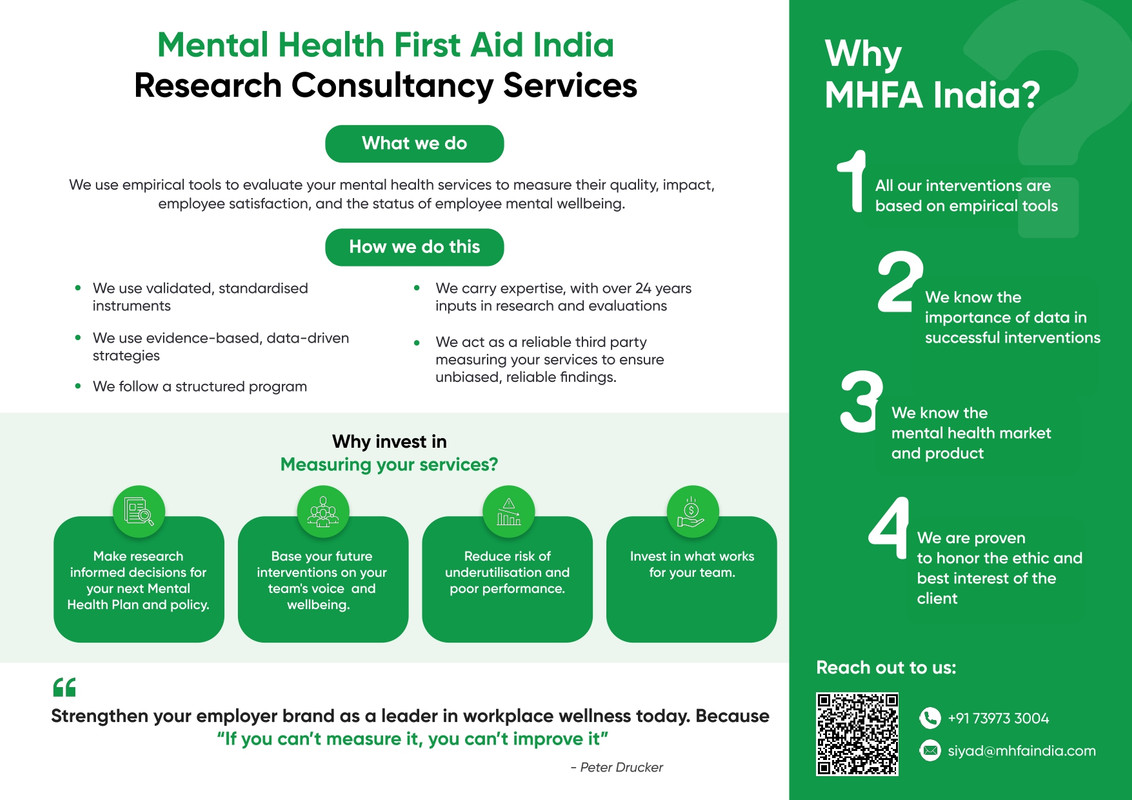
MHFA Research Consultancy Brochure
Explore the services offered by MHFA Research Consultancy and see how we can support your organization in workplace mental health strategies.
Want to learn more about MHFA's Research Consultancy?
Reach out to us through our interest form to discuss the tools and methods to evaluate your existing workplace mental health initiative.
We look forward to hearing from you.
Frequently Asked Questions (FAQ's)
What is workplace mental health assessment, and why does it matter?
It's the process of measuring whether your mental health programs are actually improving employee outcomes — not just tracking participation. Without it, organizations risk spending budgets on programs that feel good but deliver little real impact.
Our employees seem happy with our programs. Isn't that enough?
Not quite. Satisfaction and actual mental health improvement are two different things. Many employees enjoy wellness workshops in the moment but show no measurable change in stress or absenteeism afterward. Feeling good about a program is a starting point — not a finish line.
Why do so many programs underperform despite good intentions?
Usually due to a mismatch between the program and the organization. Low EAP utilization, app drop-offs after two weeks, and poor workshop follow-through all signal that program selection wasn't grounded in employee needs or organizational readiness.
How is measuring mental health different from collecting feedback?
Feedback tells you how people feel about a program. Measurement tells you whether it's actually changing behavior, reducing absenteeism, or shifting culture — using defined metrics, longitudinal tracking, and privacy-compliant data collection.
Can smaller organizations afford this?
Yes. Assessment doesn't require a large research team or enterprise budget — just clarity on goals and the right research partner. The cost of not measuring, through wasted investment and failed budget justifications, is almost always higher.
What makes MHFA India's approach different from standard HR reporting?
MHFA India combines quantitative data (what's happening) with qualitative employee insights (why it's happening). Developed across 200+ research studies, this gives organizations a far more actionable picture than dashboards or utilization reports alone.
How do you measure mental health without compromising employee privacy?
Through anonymized data, aggregate reporting, voluntary participation, and clear confidentiality policies — all built into every study framework from the start.
What ROI can organizations realistically expect?
Bell Canada reported a $4.10 return for every $1 invested. The WHO estimates a $4 productivity return per $1 spent on depression and anxiety treatment. Evidence-based programs consistently outperform those built on assumption.
What's the first step toward assessing our programs?
Define what success looks like — reduced absenteeism, stronger manager confidence, or lower attrition. Then audit your existing data and identify gaps. MHFA India's consultancy can support you at any stage.
Is MHFA India's consultancy only for large corporations?
No. MHFA India works with organizations of all sizes. The principle remains the same: every organization deserves to know whether its mental health investments are genuinely helping its people.