
Why Mental Health at Work? What Research Says

Arjun’s team loved the new meditation app subscription. It ticked the “mental health” box and made for a great HR announcement. But when deadlines piled up, stress levels soared just the same. Not all good intentions are enough without knowing what really works.
It has been well-established that attitudes towards mental wellbeing in the workplace have shifted over the last 5 years; employees are increasingly talking more openly about their mental health in the workplace, and managers are gaining mental health literacy (Mind Share Partners, 2025).
Why is Mental Health in the Workplace Important?
Globally, an estimated 12 billion working days are lost every year to depression and anxiety, according to the World Health Organization. This comes at a cost of US $1 trillion per year in lost productivity (WHO, 2024). To combat this, the workplace can provide employees with resources and supports to mitigate the risks of work-related mental health conditions, in the form of organizational interventions or wellness programs. Organizational interventions include assessing workplace risks to mental health in order to remove or prevent them (WHO, 2024).
So, where and how should employers and leaders invest to ensure employee health and wellbeing, and leverage the productivity of their workers?
Establishing mental wellbeing in the workplace is crucial to retain productive employees. Wellness programs should aim to do more than tackling just the risks to mental health. They should aim to preserve, enhance, and promote mental wellbeing and provide care for workers with mental health concerns. Leadership training, employee and family assistance programs (EFAPs), and mental wellness events and campaigns can be part of the workplace wellbeing initiative. When wellness programs are set up within organizations, leaders will notice a positive return on investment.
- For example, Canadian telecommunications company Bell measured a $4.10 CAD (nearly 262 rupees) ROI for every dollar invested into their mental health initiative (Kangasniemi et al., 2019).
- When mental health programs are sustained for three years or longer, the median annual return more than doubles, compared to when it is in place for a year (Kangasniemi et al., 2019).
- Also, programs that holistically address wellbeing are more likely to achieve a positive ROI (Kangasniemi et al., 2019).
- Therefore, employer-sponsored, evidence-based workplace mental health initiatives benefit both employees and employers (Bondar et al., 2022).
Psychological distress among employees is associated with presenteeism and absenteeism - large sources of productivity and monetary loss for a company (Gilbert-Ouimet et al., 2024). However, when companies support their employees during their absence and facilitate their return to work, absenteeism decreases (Kangasniemi et al., 2019). Bell recorded a 20% decrease on their short-term disability (STD) claims and found that supporting employees during their STD leave and on return-to-work leads to a reduction in long-term disability claims (Kangasniemi et al., 2019).
The benefits of workplace mental health initiatives go beyond monetary value: mental health literacy trainings help encourage employees to help one another and foster a workplace culture of sensitivity towards mental health. For example, over 98% of individuals who participated in Mental Health First Aid training across India significantly agreed that they could identify warning signs of mental illness, and 97% felt the training was relevant to their professional context (MHFA India Consolidated Learners’ Feedback Report, 2025).
Establishing mental health programs at work ensures that employees feel supported and valued, because while workers may encounter risks to their mental health due to work, work also supports good mental health by providing livelihood, a sense of purpose and achievement, and an opportunity for inclusion in a community (WHO, 2024).
Leaders and employers should establish their workplace wellbeing initiative by ensuring that comprehensive, long-term support is extended to employees. Leaders can advance the efficacy of their programs by measuring their impact in the workplace.
MHFA India provides organisations with the support and expertise required to measure their workplace wellness programs empirically, so that the programs you continue to engage in, really match your needs and tell you the story of change.
From standardised tools to focus group discussions, under a well-trained and experienced research team, MHFA aims to support you to take the best decisions.
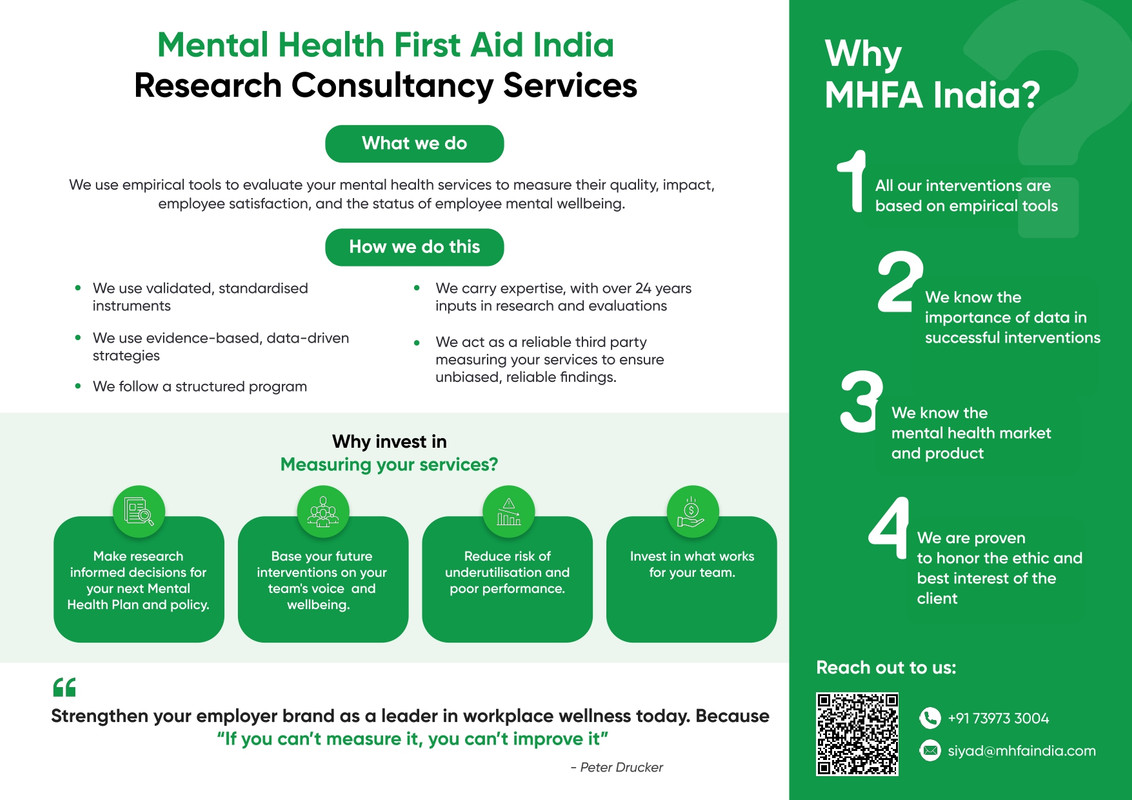
MHFA Research Consultancy Brochure
Explore the services offered by MHFA Research Consultancy and see how we can support your organization in workplace mental health strategies.
Related:
➡️ How Mental Health Found Its Way to the Top of the Agenda
➡️ Choose Your Champion: An Introduction to Popular Workplace Mental Health Programs
➡️ How Do You Know It Works? The Need for Measuring the Impact of your Workplace Mental Health Interventions Empirically
➡️ Workplace Mental Health: Why Assessment Is Critical and How MHFA India’s Research Consultancy Service Supports You
Reference
- Mental health at work - WHO
- The ROI in workplace mental health programs: Good for people, good for business - DELOITTE INSIGHTS
- Costs of Presenteeism and Absenteeism Associated With Psychological Distress Among Male and Female Older Workers - Journal
- Clinical and Financial Outcomes Associated With a Workplace Mental Health Program Before and During the COVID-19 Pandemic - Jama Network
- 2025 Mental Health at Work Report: Key Workplace Trends - Mind Share Partners
Want to learn more about MHFA's Research Consultancy?
Reach out to us through our interest form to discuss the tools and methods to evaluate your existing workplace mental health initiative.
We look forward to hearing from you.
Frequently Asked Questions (FAQ's)
Why is mental health important in the workplace?
Globally, 12 billion working days are lost every year to depression and anxiety, costing USD 1 trillion in lost productivity. The workplace is uniquely positioned to provide resources that mitigate mental health risks — making employee wellbeing both a human and business priority.
What is the ROI of investing in workplace mental health programs?
Bell Canada reported a $4.10 return for every $1 invested in their mental health initiative. Research also shows that when programs are sustained for three years or more, the median annual return more than doubles compared to short-term initiatives.
How does poor employee mental health affect business performance?
Psychological distress directly drives presenteeism and absenteeism — two of the largest sources of productivity and monetary loss for organisations. Supporting employees through absence and return-to-work processes has been shown to significantly reduce both short and long-term disability claims.
What should a workplace mental health program include?
Effective programs go beyond addressing risks — they preserve, enhance, and promote mental wellbeing. This includes leadership training, employee and family assistance programs (EFAPs), mental wellness events, and campaigns that foster a culture of openness and support.
Do wellness programs actually change workplace culture?
Yes, when done right. Mental health literacy training, for instance, equips employees to support one another. In India, over 98% of Mental Health First Aid participants reported being able to identify warning signs of mental illness, and 97% found the training directly relevant to their professional context.
How can organisations measure whether their programs are working?
Through empirical research — using standardised tools, surveys, and qualitative methods like focus group discussions. MHFA India's research consultancy helps organisations measure program impact scientifically, so investments are grounded in evidence, not assumption.