
Choose Your Champion: An Introduction to Popular Workplace Mental Health Programs

Priya’s company had it all—an EAP, a meditation app, monthly wellness workshops, even trained Mental Health First Aiders. All the boxes were ticked. But months later, utilisation of EAP stayed low, and no one could say if the programs were truly working.
There are myriad wellbeing initiatives that the market offers, and several are being implemented in workplaces worldwide. From subsidized counselling to wellness leaves to digital courses, companies follow in one another's footsteps to establish programs boasting employee retention, wellbeing, and productivity. However, the history of mental health products is very nascent and there is limited evidence on the impact of each product. Post-Covid-19, with the immediate ask responding to the needs of employees, more decisions have been based on references from networks and forums and so-called best practices and case studies.
However, an empirical approach would be the next smart action to be informed and make good decisions. This article outlines several popular workplace mental health programs and the outcomes that some research shows they have on employee welfare.
Employee Assistance Programs (EAPs)
EAPs are workplace-subsidised confidential counselling sessions for employees, and sometimes their families too. EAPs have shown to enhance employee outcomes, by increasing productivity and decreasing absenteeism in organisations (Bouzikos et al., 2022). A 27% decrease in absenteeism was found for EAP (Agovino, 2019). It also improves employee life satisfaction and decreases psychological distress, anxiety, and depression (Bouzikos et al., 2022; Milot, 2018).➡️ Related: Top 5 Alternatives to Traditional Employee Assistance Programs
Corporate wellness programs
Corporate wellness programs are more holistic, variable programs which aim to raise employee engagement levels in the workplace and improve employee health outcomes. They can include healthcare packages for employees and their families, health promotion activities such as exercise programs, and discourage unhealthy behaviours such as smoking and inactivity (Jones et al., 2019). Yoga, art therapy, sports, and wellness leaves may also be part of corporate wellness initiatives. These programs are found to have various positive effects among employees, including reduced stress levels, and improved social satisfaction, energy levels, self-efficacy and quality of life (Emerson et al., 2017).Digital mental health initiatives
Digital mental health initiatives include mobile app-based or free online subscriptions to virtual mental health platforms. They allow for on-demand, convenient access to mental health information, providing flexibility and autonomy for employees, and cost-effectiveness for organisations. Digital programs focus on stress reduction, mindfulness techniques, and cognitive behavioural therapy (CBT). These interventions can be used in conjunction with traditional support options – such as EAPs – to enhance their impact. The effectiveness of digital interventions has been found in improving a number of mental health conditions, including stress, anxiety, depression, burnout, and psychological wellbeing (Cameron et al., 2025).➡️ Related: Mental Health Programs: How India is Expanding Mental Health Support
Mental Health First Aid(MHFA)
MHFA courses are programs catered to organisations interested in training their employees as first responders to support a colleague having a mental health crisis or challenge. Aside from knowledge on the signs and symptoms of common mental health issues, individuals practice the support framework to guide them through an interaction with a colleague with empathy and care. After they become certified MHFAiders, individuals work towards creating a supportive, sensitive workplace culture. MHFA evaluation shows that it reduces stigma and improves employee productivity, retention, and morale, and encourages open discussions around employee mental health challenges (MHFA). 98.7% of employees who have taken the course report feeling confident in listening to others without being judgmental (MHFA India, 2025).It is recommended that employers routinely assess employee’s subjective wellbeing to ensure that it can be improved (University of Manchester, 2022).
What do your experiences say? Anecdotally, you hear CHROs and managers talk positively, yet it does not tell you the entire story.
MHFA India provides organisations with the support and expertise required to measure their workplace wellness programs empirically, so that the programs you continue to engage with, really match the needs and tells you the story of change.
From standardised tools to focus group discussions, under a well trained and experienced research team, MHFA aims to support you to take the best decisions.
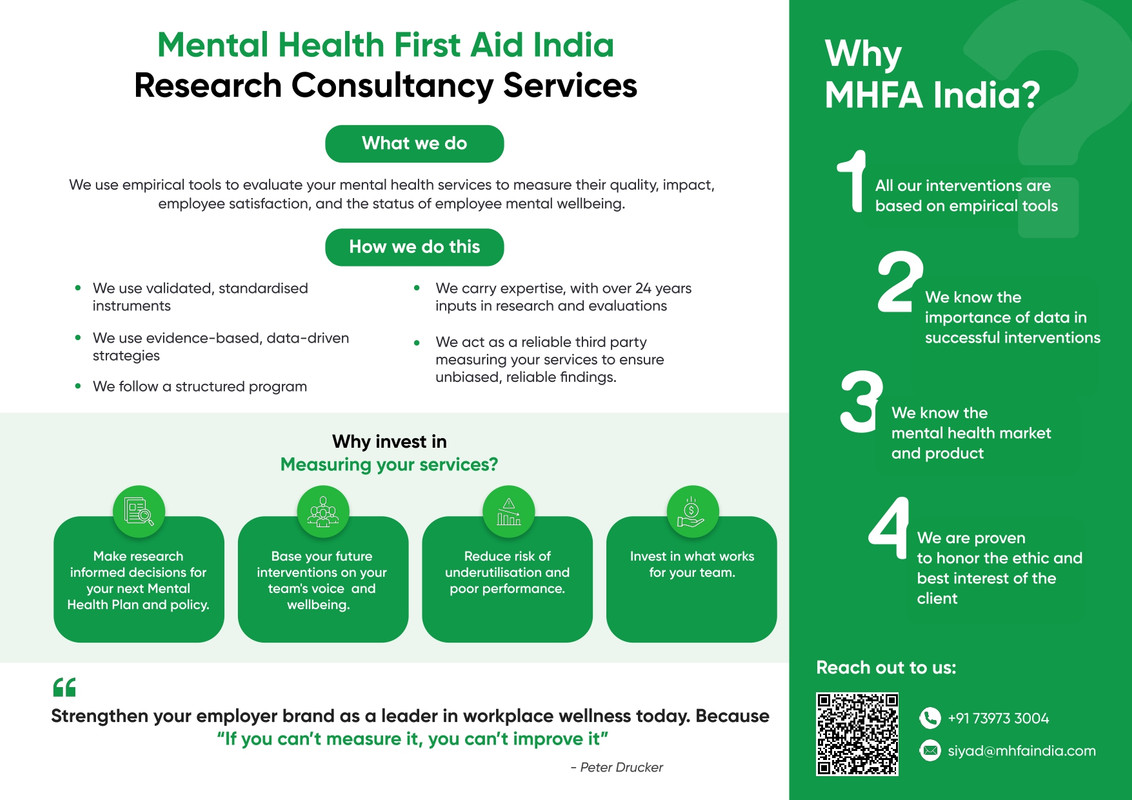
MHFA Research Consultancy Brochure
Explore the services offered by MHFA Research Consultancy and see how we can support your organization in workplace mental health strategies.
Related:
➡️ How Mental Health Found Its Way to the Top of the Agenda
➡️ Why Mental Health at Work? What Research Says
➡️ How Do You Know It Works? The Need for Measuring the Impact of your Workplace Mental Health Interventions Empirically
➡️ Workplace Mental Health: Why Assessment Is Critical and How MHFA India’s Research Consultancy Service Supports You
➡️ Why Every Workplace Needs Mental Health Champions: Certificate Training Explained
Reference
- The impact of a Canadian external Employee Assistance Program on mental health and workplace functioning: Findings from a prospective quasi-experimental study: Tandfonline - Marc Milot
- Evaluating the effectiveness of employee assistance programmes: a systematic review
- What do Workplace Wellness Programs do? Evidence from the Illinois Workplace Wellness Study
- Effects of an employee exercise programme on mental health
- Effectiveness of Digital Mental Health Interventions in the Workplace: Umbrella Review of Systematic Reviews
- Business leaders urged to measure employee wellbeing
- Mental Health First Aid at Work - MHFA USA
- Contextualising the Effectiveness of an Employee Assistance Program Intervention on Psychological Health: The Role of Corporate Climate
- Companies Seek to Boost Low Usage of Employee Assistance Programs - SHRM
Want to learn more about MHFA's Research Consultancy?
Reach out to us through our interest form to discuss the tools and methods to evaluate your existing workplace mental health initiative.
We look forward to hearing from you.
Frequently Asked Questions (FAQ's)
Why should organisations measure their workplace mental health programs?
Running programs and knowing they work are two different things. Less than 27% of organisations critically assess whether their wellbeing initiatives actually improve employee outcomes. Without measurement, you risk spending on programs that aren't helping your employees or your business.
Are feedback forms enough to measure program effectiveness?
No. Feedback forms capture opinions, not outcomes. They don't use validated tools or scientific methods. Empirical research goes deeper — telling you which programs are most utilised, whether real behavioral change is happening, and whether your investment is justified.
What is empirical research in the context of workplace mental health?
It's a scientific, evidence-based approach that uses standardised tools, surveys, and qualitative methods like focus groups to reliably measure whether your mental health programs are achieving their intended purpose.
What does MHFA India actually measure?
MHFA India measures intervention effectiveness, mental health status of your team, service quality, employee perceptions, user satisfaction, and ROI — all while maintaining respondent confidentiality and safety.
Why is EAP utilisation so low in India?
Average EAP utilisation in India sits around 5%. Stigma, lack of awareness, accessibility barriers, and confidentiality concerns all play a role. Measurement helps identify which specific factor is affecting uptake in your organisation so you can address it directly.
What is the business cost of not measuring mental health programs?
India's projected economic loss due to mental health conditions between 2012–2030 is estimated at USD 1.03 trillion. Organisations that skip measurement miss opportunities to reduce absenteeism, lower attrition, and improve productivity.
How qualified is MHFA India to conduct this research?
MHFA India has empirically measured mental health program impact across 200+ global research studies. Research is core to their work — not an add-on.
Will the research process disrupt our existing programs?
No. MHFA India's consultancy works alongside your existing initiatives — assessing what's in place and helping you decide what to continue, adjust, or replace.
What does an organisation gain from MHFA India's research consultancy?
Clear, evidence-based answers about which programs deliver real value — so your mental health investments match your organisation's actual needs and your employees receive support that genuinely works.