
How Mental Health Found Its Way to the Top of the Agenda
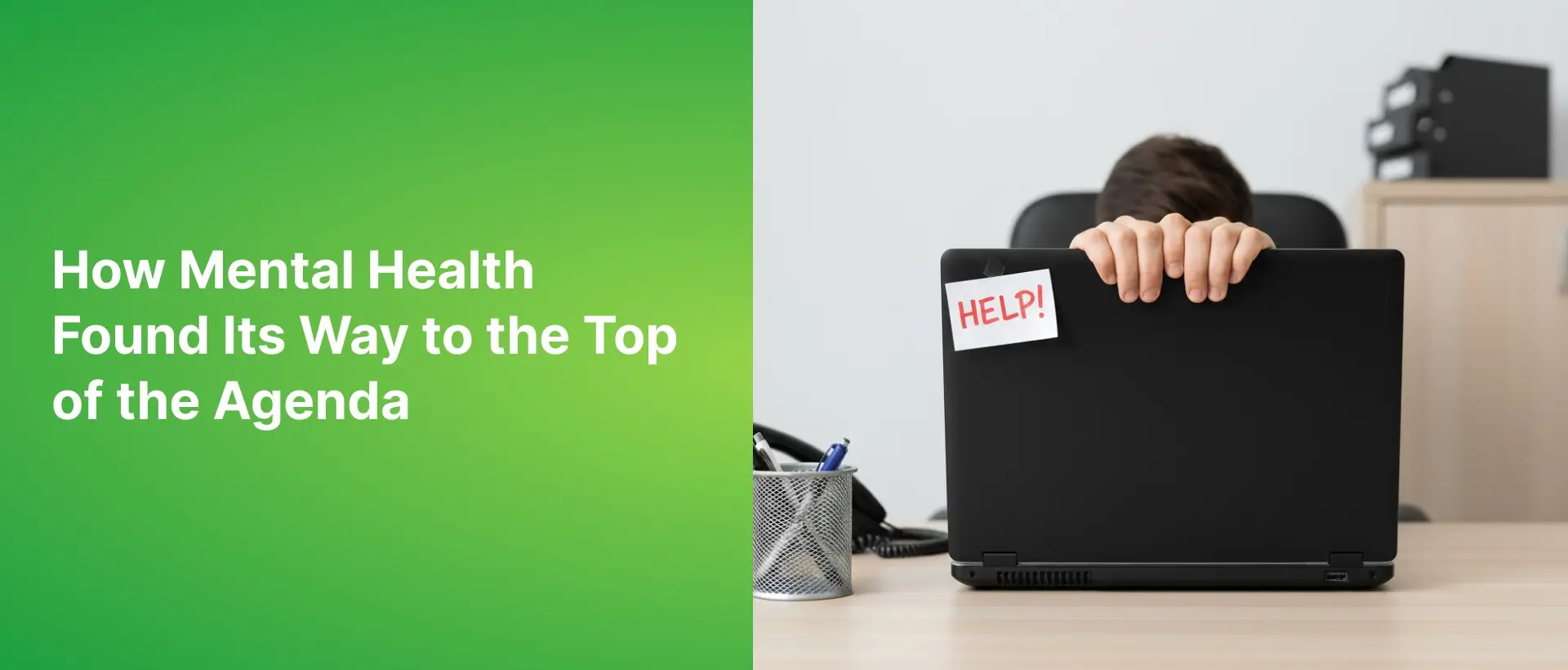
When Neha joined her company in 2018, “wellness” meant an annual health check-up and a fruit basket. By 2024, she was attending therapy sessions covered by work, joining resilience workshops, and taking part in “no-meeting Fridays.” The initiatives were plenty—but no one knew which ones were actually making a difference.
Up until recently, mental health in the workplace was considered just a perk – now, it’s a priority. In the years before COVID-19, less than half of US employees felt that mental health was prioritised at their company, yet 86% of them felt that their company’s culture should support mental health (HBR, 2019). Even today in India, 86% of employees reported “struggling” or “suffering” in their current roles, according to a report by Gallup (2025).
1 in 4 Indian employees find it hard to speak up about stress, burnout, depression, or anxiety without fearing judgement (Economic Times, 2024). Even leadership ranked “stigma reduction” in their workplace lowest on a list of 11 behavioural health initiatives (McKinsey, 2021).
The COVID-19 pandemic had a significant, measurable impact on the increase of mental disorders worldwide, summarised below.
| Mental Health Issues | Prevalence Post-COVID-19 |
|---|---|
| Major depressive disorder | 25% increase in prevalence worldwide¹ |
| Anxiety disorders | 25% increase in prevalence worldwide¹ |
| Employees reporting at least one symptom of a mental health condition | 76% of employees in 2021² |
WHO, 2022; HBR, 2021
Since then, organisations have been taking measures to support their employees’ wellbeing by increasing their focus on mental health, and providing support based on individuals’ needs (CIPD, 2021). There has been an increase in corporate efforts to implement a formal wellbeing strategy in the workplace, and more HR professionals believe that senior leadership have employee wellbeing on their agenda (CIPD, 2021).
The data says that:
- Mental health has been the most common focus of wellbeing activity, with 57% of organisations focusing on it to a large extent in 2021, as compared to 41% in 2020 (CIPD, 2021).
- Now, over 53% of organisations have a standalone wellbeing strategy (CIPD, 2023).
- In 2020, 70% of organisations provided counselling services or Employee Assistance Programs (EAPs) to their employees. In 2023, 84% of organisations had EAPs (CIPD, 2023).
Mental health capacities among leadership have also been on the rise:
- In 2021, only 21% of employees said that managers were equipped to support mental health (Mind Share Partners, 2021).
- In 2025, 64% of employees say their manager could support them if they have a mental health challenge (Mind Share Partners, 2025).
- Mental Health First Aid (MHFA) training has also been increasingly taken up by individuals and corporates across the world, with MHFA reaching 8 million+ people across the world.
- MHFA India (a newly introduced concept during COVID in the country) reported a total of 25 trainings in 2019 and an increase to 60 trainings in 2021.
Today, organisational mental health policies factor into employees’ performance and decisions about their future at their organisation. Employees who work at a company that supports their mental health are twice as likely to report no burnout or depression, and twice as likely to stay at the company for two years or more (Mind Share Partners, 2025). Therefore, supporting employees’ mental health encourages better work performance, retention, and overall wellbeing.
As the corporate sensitivity toward mental health has increased, the pursuit for various mental wellbeing initiatives at work has increased and so has the market with various offerings: from EAPs, to Mental Health First Aid training, awareness sessions, yoga workshops, and so on.
We all agree that mental health support at work is here to stay, and efforts should be structured and organised aiming for sustainability and impact.
To assure sustainability and impact, leaders may need to take a pause and measure what has worked best for employees' health and performance outcomes so far. Do teams have the same needs, are all benefiting? If not, why?
MHFA India provides organisations with the support and expertise required to measure their workplace wellness programs empirically, so that the programs you continue to engage in, match your needs and tell you the story of change.
From standardised tools to focus group discussions, under a well-trained and experienced research team, MHFA aims to support you to take the best decisions.
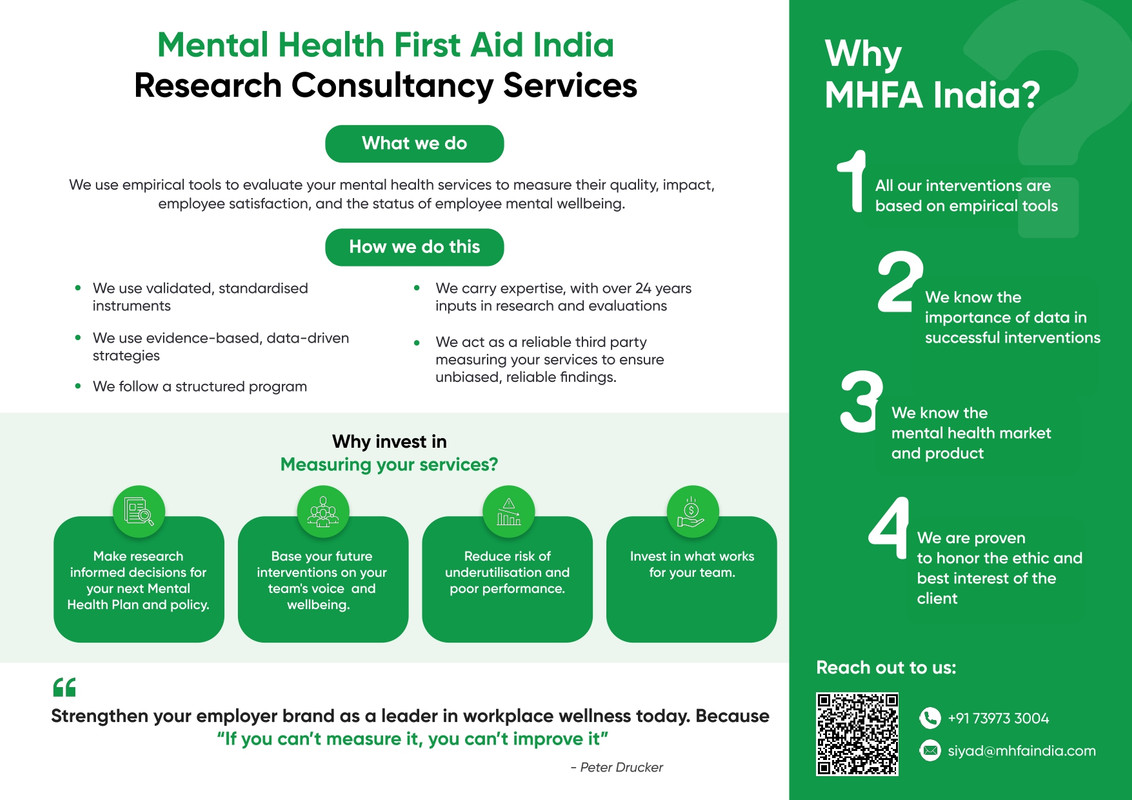
MHFA Research Consultancy Brochure
Explore the services offered by MHFA Research Consultancy and see how we can support your organization in workplace mental health strategies.
Related:
➡️ Why Mental Health at Work? What Research Says
➡️ Choose Your Champion: An Introduction to Popular Workplace Mental Health Programs
➡️ How Do You Know It Works? The Need for Measuring the Impact of your Workplace Mental Health Interventions Empirically
➡️ Workplace Mental Health: Why Assessment Is Critical and How MHFA India’s Research Consultancy Service Supports You
➡️ Why Every Workplace Needs Mental Health Champions: Certificate Training Explained
Reference
- Overcoming stigma: Three strategies toward better mental health in the workplace
- Research: People Want Their Employers to Talk About Mental Health - by Kelly Greenwood, Vivek Bapat and Mike Maughan
- It’s a New Era for Mental Health at Work by Kelly Greenwood and Julia Anas
- Mind Share Partners' - 2021 Mental Health at Work Report
- Mind Share Partners - 2025 Mental Health at Work Report Key Workplace Trends
- Health and wellbeing at work - CIPD’s Report
- Health and wellbeing at work 2021: survey report
- A quarter of all employees struggle to voice mental health issues at workplace : Survey
- COVID-19 pandemic triggers 25% increase in prevalence of anxiety and depression worldwide
- State of the Global Workplace - Gallup
Want to learn more about MHFA's Research Consultancy?
Reach out to us through our interest form to discuss the tools and methods to evaluate your existing workplace mental health initiative.
We look forward to hearing from you.
Frequently Asked Questions (FAQ's)
How much has corporate investment in mental health grown?
Significantly. Organisations focusing on mental health jumped from 41% in 2020 to 57% in 2021. EAP adoption grew from 70% in 2020 to 84% by 2023, and over 53% of organisations now have a standalone wellbeing strategy.
Have managers become better at supporting employee mental health?
Yes, notably. In 2021, only 21% of employees felt their manager could support them through a mental health challenge. By 2025, that figure had risen to 64% — a significant shift in leadership capability and awareness.
Why do employees still hesitate to speak about mental health at work?
Stigma remains a real barrier. 1 in 4 Indian employees find it hard to speak up about stress, burnout, or anxiety without fearing judgement. Notably, even leadership ranked stigma reduction lowest among 11 behavioural health initiatives — highlighting a gap between intention and action.
What's the business case for supporting employee mental health?
Employees at companies that support mental health are twice as likely to report no burnout or depression, and twice as likely to stay for two or more years. Better mental health support directly improves performance, retention, and overall workplace wellbeing.
What role has Mental Health First Aid played in this shift?
MHFA has been a significant driver of mental health literacy globally, reaching 8 million+ people worldwide. In India, MHFA trainings grew from just 25 in 2019 to 60 in 2021 — reflecting rapid corporate uptake during and after the pandemic.
How does MHFA India help organisations move from programs to impact?
MHFA India's research consultancy uses standardised tools and qualitative methods to empirically measure your wellness programs — helping you understand what's working, for whom, and why — so every investment tells a real story of change.