
How Do You Know It Works? The Need for Measuring the Impact of your Workplace Mental Health Interventions Empirically

Rahul’s workplace championed wellbeing with a mix of EAP services, workshops, and peer support. The programs were running smoothly—yet without data, no one knew if they were helping employees or just filling the calendar.
By now, the importance of having a comprehensive workplace wellbeing initiative in today’s workplace has been well established. You may even be having a few of the programs in place in your organisation already. But how do you know what works?
According to the Chartered Institute of Personnel and Development, UK, less than half of organisations (48%) take a continuous feedback loop to improve their wellbeing program, and fewer (27%) critically assess the quality of wellbeing outcomes for employees who participate in interventions (2023). Given all the benefits of having workplace wellness programs, it appears that their uptake remains very low: the average utilisation rate for EAP in India is around 5% (Business Standard, 2022). While this may be for various reasons – mental health stigma, lack of awareness, accessibility or confidentiality concerns – it remains crucial for employers to understand why the uptake remains low, so as to make appropriate changes to their programs and increase the utilisation.
Poor mental health at work has a price: India’s economic loss due to mental health conditions, between 2012-2030, is estimated at USD 1.03 trillion (Govt of India, 2025). When mental health services are measured for effectiveness, organisations will be able to make the most of them. With the right interventions, employers can bring down presenteeism and absenteeism in their organisations, reduce turnover, and increase productivity and engagement in the workplace (Franco, 2025).
Methods we use to Measure
Empirical research is a scientific approach of gaining knowledge by testing theories or practices. The goal is to produce reliable and valid information to validate or invalidate whether purpose of the services is being achieved or not. Empirical research uses methodical and evidence-based approaches to conduct qualitative, quantitative, or mixed-methods research. Our research follows a mixed-methods approach, where we use strategies from both qualitative and quantitative methods to provide a greater understanding of mental health programs at your workplace. Standardised tools such as surveys and questionnaires are used to generate quantitative data and help us in our objective analysis, after which the qualitative tools are used to deepen the insights from your employees.
Feedback forms VS Empirical Studies
While the feedback forms collect participants’ opinions and experiences with the course, they are not a systematic means of collecting evidence to generate knowledge. Feedback forms do not utilise standardised, validated tools or a scientific process, the way empirical methods do. Feedback forms have a limited scope: what did participants think of one particular training? They are not rigorously tested, and participants may falsely report the way they felt about the intervention. On the other hand, our empirical method will give employers answers to many questions they may have: which programs are most utilised at their workplace; whether to continue certain programs; and employee perceptions of core services.
Best Practices and Anecdotal Stories
“We need to measure more than reach.” While certain programs are trumpeted as best practices, they do not necessarily assure success in your settings. Stories about programs going positively and people liking it in casual corridor conversations or verbal responses, are not enough for you to know the real story.
What we Measure
- Mental health status of your team ethically while keeping respondents safe.
- Effectiveness of MH interventions- snapshot, or pre and post-test data
- Quality of the service- engaging users and providers
- Perceptions
- ROI of a service
- User satisfaction with the service
- In-depth, qualitative data from users about their experience
At MHFA India we are well-versed with data as its part of our day-to-day work. In addition to empirically measuring the impact of the MHFA program (200+ global research) routinely, we measure the output of every mental health initiative and changes the bring for every learner.
MHFA India provides organisations with the support and expertise required to measure their workplace wellness programs empirically, so that the programs you continue to engage with, really match your needs and tells you the story of change.
From standardised tools to focus group discussions, under a well trained and experienced research team, MHFA aims to support you to take the best decisions.
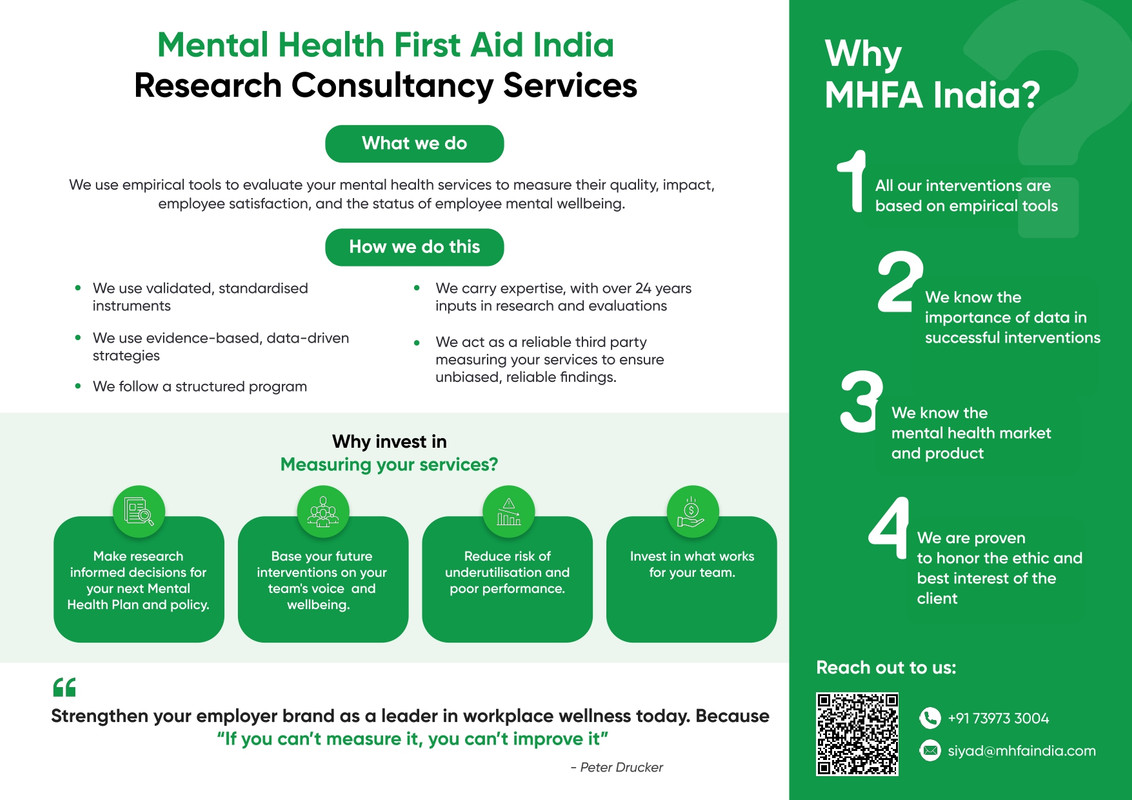
MHFA Research Consultancy Brochure
Explore the services offered by MHFA Research Consultancy and see how we can support your organization in workplace mental health strategies.
Related:
➡️ Choose Your Champion: An Introduction to Popular Workplace Mental Health Programs
➡️ Why Mental Health at Work? What Research Says
➡️ How Mental Health Found Its Way to the Top of the Agenda
Reference
- Advancing Mental Healthcare in India - PIB
- Can EAPs be game changers for corporate wellness?
- Health and wellbeing at work - CIPD’s Report
- Employee Assistance Programs Statistics and Utilization Rates - Daniela D. Franco, Social Psychologist
Want to learn more about MHFA's Research Consultancy?
Reach out to us through our interest form to discuss the tools and methods to evaluate your existing workplace mental health initiative.
We look forward to hearing from you.
Frequently Asked Questions (FAQ's)
Why should organisations measure their workplace mental health programs?
Running programs and knowing they work are two different things. Less than 27% of organisations critically assess whether their wellbeing initiatives actually improve employee outcomes. Without measurement, you risk spending on programs that aren't helping your employees or your business.
Are feedback forms enough to measure program effectiveness?
No. Feedback forms capture opinions, not outcomes. They don't use validated tools or scientific methods. Empirical research goes deeper — telling you which programs are most utilised, whether real behavioral change is happening, and whether your investment is justified.
What is empirical research in the context of workplace mental health?
It's a scientific, evidence-based approach that uses standardised tools, surveys, and qualitative methods like focus groups to reliably measure whether your mental health programs are achieving their intended purpose.
What does MHFA India actually measure?
MHFA India measures, intervention effectiveness, mental health status of your team, service quality, employee perceptions, user satisfaction, and ROI — all while maintaining respondent confidentiality and safety.
Why is EAP utilisation in so low in India?
Average EAP utilisation in India sits around 5%. Stigma, lack of awareness, accessibility barriers, and confidentiality concerns all play a role. Measurement helps identify which specific factor is affecting uptake in your organisation so you can address it directly.
What is the business cost of not measuring mental health programs?
India's projected economic loss due to mental health conditions between 2012–2030 is estimated at USD 1.03 trillion. Organisations that skip measurement miss opportunities to reduce absenteeism, lower attrition, and improve productivity.
How qualified is MHFA India to conduct this research?
MHFA India has empirically measured mental health program impact across 200+ global research studies. Research is core to their work — not an add-on.
Will the research process disrupt our existing programs?
No. MHFA India's consultancy works alongside your existing initiatives — assessing what's in place and helping you decide what to continue, adjust, or replace.
What does an organisation gain from MHFA India's research consultancy?
Clear, evidence-based answers about which programs deliver real value — so your mental health investments match your organisation's actual needs and your employees receive support that genuinely works.