
How to Support Employees with Schizophrenia at Work

Nobody talks about the colleague who eventually stopped coming to office. Or the one quietly moved to a corner desk after a hospitalisation nobody acknowledged. Or the one who resigned, after a long period of absenteeism, with a vague email about "personal reasons”. Schizophrenia exists inside India’s workplaces: in IT parks, in banks, in classrooms, in newsrooms. It always has. What doesn’t exist, in most of those places, is any real understanding of what to do about it.
What is schizophrenia?
Schizophrenia is a serious, long-term mental health condition that distorts a person’s perception of reality. A person may hear voices others cannot hear, hold beliefs that feel real but aren’t, or see things that don’t exist. These are called psychotic symptoms. Outside of these, there is a gradual deterioration in self-care, emotional responses, thinking, behaviour, and daily functioning.
According to the National Mental Health Survey of India (NIMHANS, 2015–16), schizophrenia affects roughly 0.42% of Indian adults, cutting across income and social backgrounds. It most commonly emerges between the ages of 18 and 30, striking millions during their prime working years (30–49). In India, stigma and limited access to care often delay treatment by years, allowing the illness to worsen well beyond where early support would have helped.
What are the symptoms of schizophrenia?
Symptoms fall into three broad categories:
- Positive symptoms: Hallucinations, delusions, and disorganised thinking: experiences added to a person’s reality that wouldn’t normally be there.
- Negative symptoms: Reduced emotional expression, loss of motivation, diminished pleasure (anhedonia), and social withdrawal. These are often the most disabling and hardest to treat.
- Cognitive symptoms: Impaired memory, attention, and processing speed, a kind of “cognitive fog” that makes multitasking and complex work genuinely exhausting.
Schizophrenia is treatable. With the right medication, therapy, and support, many people lead stable, meaningful, professional lives.
What are the 5 A’s of schizophrenia?
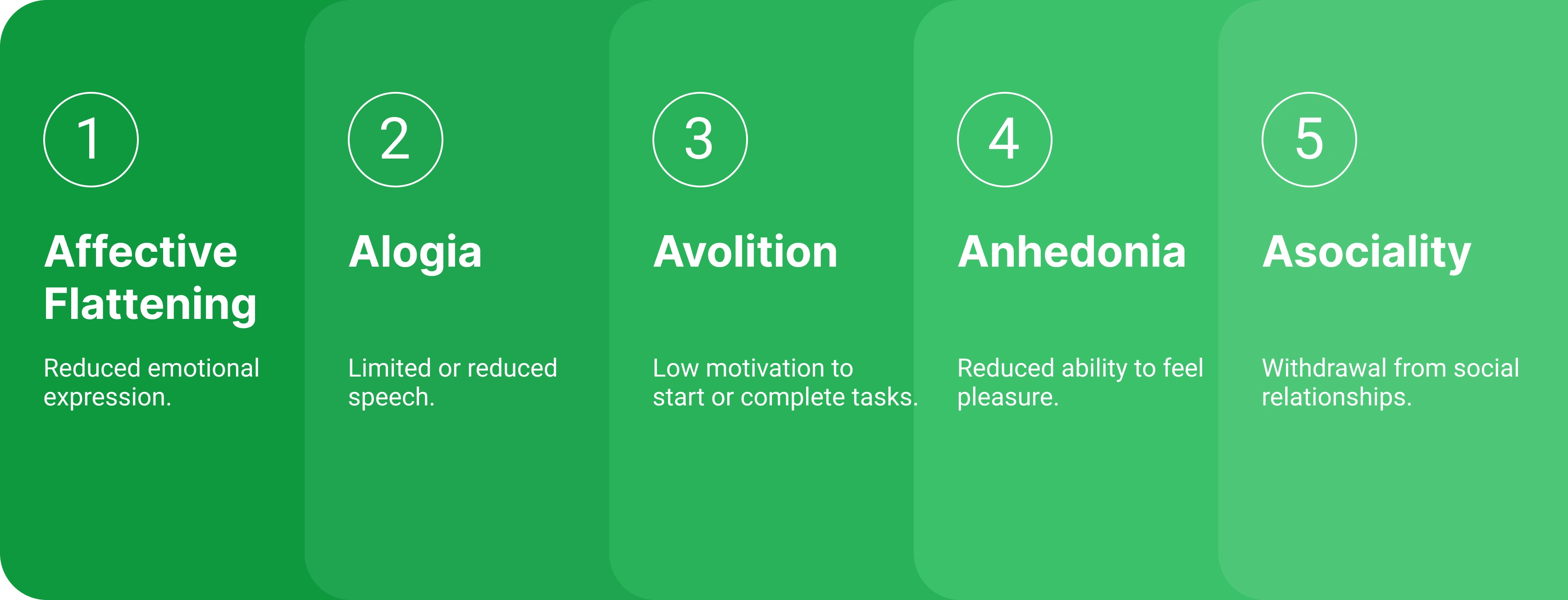
The 5 A’s describe the negative symptom cluster, often more debilitating than the dramatic symptoms people typically associate with schizophrenia.
1. Affective Flattening: Refers to neurological dampening of emotional display.It is manifested as reduced facial expression, monotone speech, and poor eye contact.
2. Alogia: Poverty of speech: Brief, empty, or delayed responses arising from cognitive difficulty, not disinterest.
3. Avolition: Is lack of motivation and inability to initiate or sustain activities. Maintaining work routines can feel impossible. This is not laziness.
4. Anhedonia: Inability to feel pleasure from previously enjoyable activities, including social interaction and hobbies.
5. Asociality: Withdrawal from relationships and social environments. This is not introversion but a progressive retreat from connection.
In the workplace, the 5 A’s are frequently misread as disengagement or incompetence. They are symptoms, and they call for understanding, not discipline.
Common Misconceptions About Schizophrenia
Myth: People with schizophrenia are dangerous.
Fact: They are far more likely to be struggling quietly than posing risk to others.
Myth: They cannot hold jobs or responsibilities.
Fact: With treatment and accommodation, many work successfully across a wide range of roles.
Myth: Schizophrenia means ‘split personality.’
Fact: That is dissociative identity disorder, a completely different condition. Schizophrenia involves disrupted perception, not multiple personalities.
These myths shape hiring, promotion, and whether a colleague gets support or a performance improvement plan for symptoms they cannot fully control.
The Impact of Schizophrenia at Work
The employment gap is significant:
- Globally, only 12%–39% of people with schizophrenia hold paid employment, with some studies placing it as low as 4%–5%. (Marwaha & Johnson, Social Psychiatry and Psychiatric Epidemiology, 2004; Tsang et al., Psychiatric Rehabilitation Journal, 2010)
- In India, unemployment among people with schizophrenia can be as high as 80%, with many of those who are employed working below their qualification level. (Loganathan & Murthy, Indian Journal of Psychiatry, 2008)
- Around 24% of people with schizophrenia were employed three years before diagnosis; only 10% remained employed five years after. (Rinaldi et al., Psychiatric Bulletin, 2008)
- Schizophrenia is among the top contributors to disability-adjusted life years (DALYs) from mental disorders in India. (India State-Level Disease Burden Initiative Mental Disorders Collaborators, Lancet Psychiatry, 2020)
These numbers don’t reflect incapability. They reflect the absence of support. Work provides identity, routine, and self-worth. With the right systems, people with schizophrenia can and do thrive professionally.
Workplace Challenges for People with Schizophrenia in India
The challenges cluster around three areas: symptoms, systems, and stigma.
Stigma and Discrimination
Over half of Indian workers with diagnosed mental health conditions do not disclose them at work, fearing discrimination or job loss. The cost of being seen often outweighs the benefit of being supported. One documented account describes a person being called “pagal” (mad) by colleagues when symptoms surfaced, a response that is far more common than most workplaces care to admit.
Symptom and Treatment Barriers
Cognitive fog, medication side-effects, and sensitivity to noise or unpredictability make many standard Indian office environments genuinely difficult to function in. Research identifies persistent symptoms, hectic environments, and lack of institutional support as key reasons people with schizophrenia lose jobs. Despite the availability of treatment, people with schizophrenia in the workplace face several barriers to accessing consistent care. These include the inability to take leave for doctor consultations, the need to conceal medications from colleagues due to fear of stigma, and workplace insurance policies that often exclude outpatient treatment and psychiatric consultations. Additional barriers include the high out-of-pocket cost of medications, lack of awareness about mental health entitlements, limited access to mental health professionals, and the fear that disclosing a diagnosis may jeopardise employment or career growth. Together, these obstacles can delay treatment, worsen outcomes, and make sustained recovery significantly harder.
Lack of Formal Accommodation
Research by Thara & Srinivasan (NIMHANS Journal) identifies accommodations that can make a meaningful difference — job coaching, flexible scheduling, and modified performance appraisals. Yet in practice, these are rarely implemented. Most employees are left to self-advocate in silence or not advocate at all.
Recognising Signs of Schizophrenia in Employees
Someone who is developing schizophrenia may commonly show the following symptoms:
- A noticeable decline in personal hygiene, grooming, and day-to-day self-maintenance.
- Conversations may go off-topic, become difficult to follow, or turn incoherent at times.
- Difficulty following fast-moving discussions or needing instructions repeated.
- Withdrawal from the team: eating alone, speaking less, avoiding colleagues.
- Tasks taking longer, missed deadlines, visible exhaustion that sleep doesn’t fix.
- Heightened sensitivity to noise, pressure, or schedule changes.
- Anxiety or confusion that seems disproportionate to the situation.
None of these signs alone confirm a diagnosis. Together, though, they signal that someone needs support, not scrutiny. A simple private check-in: “I’ve noticed you seem under a lot of strain. Is there anything we can adjust?” It can make all the difference.
How can we support individuals with schizophrenia in the workplace?
For colleagues:
- Watch your words. Skip the "pagal" or "mental" jokes. They do real damage.
- Stay the same. Treat them normally. Being a steady, consistent friend is incredibly powerful.
- Keep them included. Invite them to tea, lunch, and meetings just like anyone else.
- Speak to them. Don’t talk behind their back. Engage them directly.
- Don't assume. If you’re unsure what they can handle, just ask them.
- Keep it natural. Don’t avoid eye contact or act hesitant. Stay human.
For managers:
- Listen without judgement.
- Ask what helps, then act on it.
- Respect confidentiality.
- Check in during high-stress periods.
- The goal is not to treat someone as fragile, but to create conditions where they can be consistent and confident.
➡️ Related: Supporting Mental Health for HR and Managers
How Can Employers Support Employees with Schizophrenia?
India does have a legal framework for mental health at work, but it functions more like a safety net than a support system. The RPwD Act of 2016 sets the foundation by mandating 4% job reservations for persons with disabilities and requiring “reasonable accommodation.” The Mental Healthcare Act of 2017 promises dignity and access to treatment.
But here’s the catch: these laws are passive. They rely on employees coming forward, disclosing their condition, and asking for support — something many people with schizophrenia simply do not feel safe doing. Even the labour reforms introduced in 2019–20 did not explicitly include mental health protections, leaving huge gaps between policy and lived experience.
So the real question is: what can employers do when the law isn’t enough?
What Are Progressive Employers Doing?
Forward‑thinking organisations are stepping up in ways that go beyond compliance and actually address the lived realities of their employees.
1. Train managers in Mental Health First Aid (MHFA)
MHFA equips leaders to spot early signs of distress, respond with empathy, and guide employees toward help. In India, MHFA-certified programmes already exist, and companies that adopt them see culture shifts almost instantly.
2. Build accommodation processes before anyone asks
Organisations can design flexible work systems, modified appraisal methods, quiet rooms, predictable schedules, and clear task frameworks so that support is available proactively.
3. Strengthen Employee Assistance Programs (EAPs)
EAPs become genuinely impactful when they include psychiatric referrals and not just counselling hotlines. This bridges the crucial gap between workplace support and clinical care.
4. Include psychiatric treatment in group insurance
Thanks to IRDAI guidelines, organisations can now integrate mental health coverage into their insurance policies — and doing so sends a powerful message that mental health is as real as any physical condition.
5. Audit workplace culture for psychological safety
Because no policy works if employees feel judged, punished, or sidelined for asking for help. Psychological safety must become a leadership KPI, not a footnote.
Proof That Workplace Support Works
There are Indian examples that show just how effective these efforts can be:
NIMHANS’ UDYOG programme goes even further by matching individuals with mental illnesses to jobs based on their strengths, then supporting them through placement and adjustment.
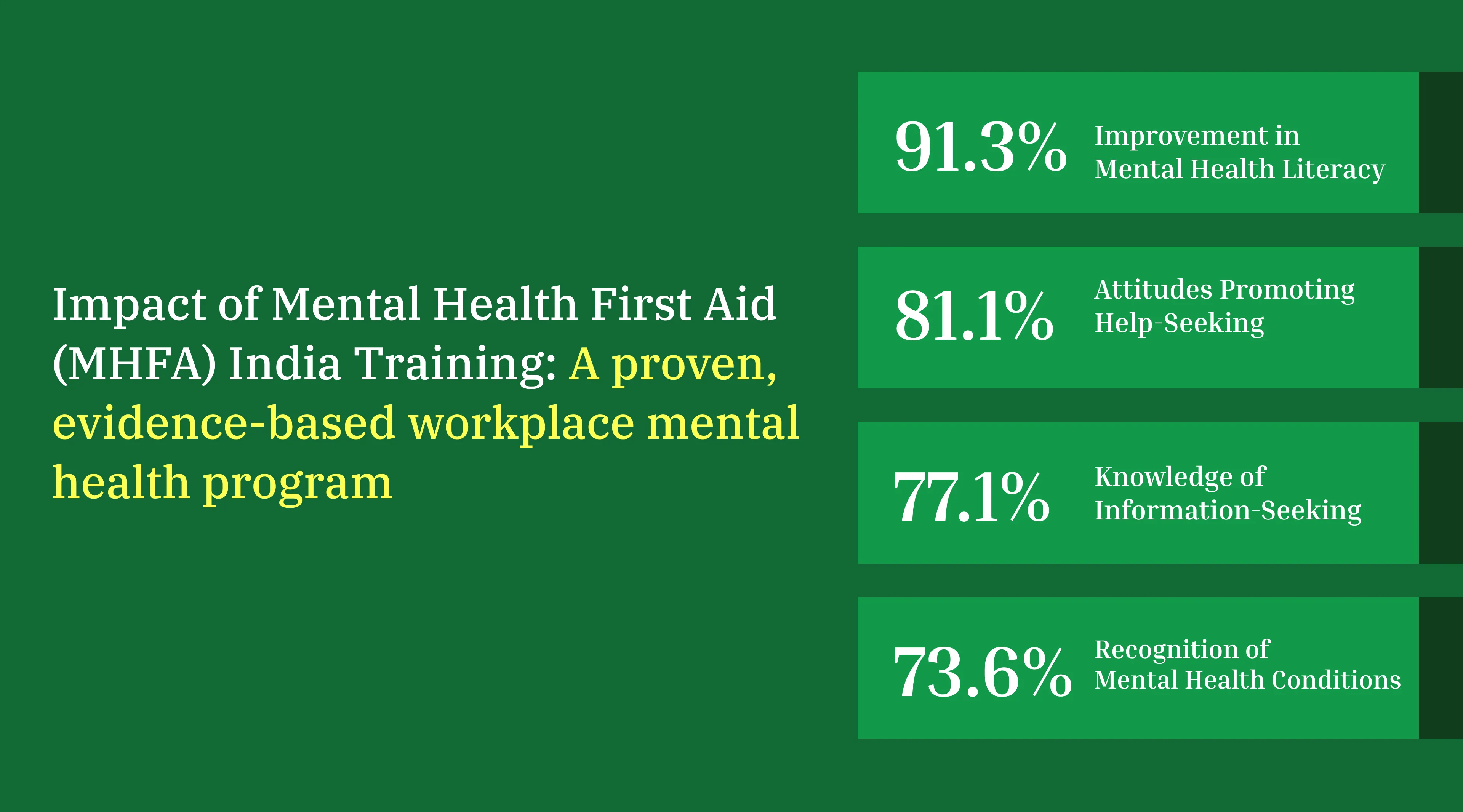
Mental Health First Aid (MHFA) India training is a proven, evidence-based tool for the workplace. Just like physical first aid, it teaches employees to spot early warning signs and guide colleagues toward professional help. You don’t need to be a therapist to make an impact.
The data is clear of MHFA impact report: after training, over 91.37% of participants significantly improved their mental health literacy. Specifically, help-seeking attitudes rose by 81.1%, knowledge increased by 77.1%, and the ability to recognize conditions grew by nearly 73.6%. In a country where stigma often keeps people with schizophrenia silent, having an MHFA-trained peer in the room creates a safe, measurable bridge to support.
These programmes work. The challenge now is scale. How do we take what a few pioneering organisations have built and turn it into standard practice across India’s workplaces?
What are the Strategies for Supporting Employees with Schizophrenia?
At the Work Level
- Flexible hours to accommodate medication schedules and morning fatigue.
- Hybrid or remote work options to reduce sensory overload.
- Quiet or low-stimulation workspaces.
- Written instructions alongside verbal ones.
- Smaller task steps and digital checklists to manage cognitive load.
At the Management Level
- Regular check-ins on workload and wellbeing, not just output.
- Distress-recognition training for managers.
- Functional disclosure approach: focus on adjustments, not diagnosis.
At the Organisational Level
- Access to care through third-party provider with psychiatric referral capacity
- Mental health coverage in group insurance.
- Non-punitive leave policies and proactive accommodation processes.
- Quiet rooms and anti-stigma training.
- Occupational Therapy integration for those returning to or adapting within work.
➡️ Related: Employee Stress: A Business Risk, Not Just an HR Responsibility
How Can MHFA Support Employees with Schizophrenia?
MHFA-trained colleagues and managers are not there to diagnose. They are there to notice, listen, and connect. They can recognise early signs of distress, approach the person without judgement, and guide them toward appropriate professional support through EAPs, HR, or clinical services.
More broadly, MHFA shifts culture. It turns fear into understanding, avoidance into conversation, and apt responses to crisis. In a country where stigma silences many, an MHFAider is often the first real safety net to a struggling employee encounter.
India and the World: A Global Context
Schizophrenia’s global prevalence (0.3–0.4%) mirrors India’s figures. The difference lies in how countries respond. Internationally, many countries have gone further than India in formalising the duty to accommodate mental illness at work.
- Canada: The Canadian Human Rights Act explicitly requires employers to adjust policies, including flexible hours, duty reassignments, and more, unless doing so causes undue hardship.
- United States: The Americans with Disabilities Act recognises severe mental disorders including schizophrenia as disabilities and mandates an “interactive process” between employer and employee to grant accommodations such as modified schedules or remote work.
- United Kingdom and EU: NICE guidelines and broader EU directives push employers toward proactive psychological safety frameworks, with public education and employer training built into the system.
- India: Currently lacks an explicit “interactive accommodation” duty. Disabled workers must themselves identify, request, and sometimes fight for each adjustment, a burden that falls hardest on those least equipped to carry it.
Stigma is universal, and misconceptions about schizophrenia persist everywhere. High-income nations tackle this by pairing laws with training like the WHO/ILO guidelines. India is starting to do the same through NGOs, though we have a long way to go.
Interestingly, tight-knit communities in developing regions often support workers better than cold corporate offices. The big lesson? Laws aren't enough and neither is just "being nice." You need both legal rights and a supportive community working together.
The Larger Point
The reason schizophrenia at work stays invisible in India is not because people with the condition are absent from workplaces. They are there. They have always been there. They are just hiding because the cost of being seen is too high.
That cost is not fixed. It is a product of culture, of leadership, of whether a manager asks how someone is doing and actually means it, of whether a company’s mental health policy is a real thing or a PDF sitting on a server no one visits.
India has the laws. Organisations are proving the programmes work. What’s missing is the will to make it normal: normal to ask for help, normal to need a different kind of support, and still be valued as a professional.
That’s not a government problem. It starts in every office, in every team, every day.
Frequently Asked Questions (FAQ's)
Are there online courses or workshops for caregivers of people with schizophrenia?
Caregivers can find evidence-based training through Mental Health First Aid (MHFA) India which focuses on recognizing warning signs and providing non-judgmental support. Carers Worldwide also offers community-based learning and peer support groups specifically designed for family carers to build confidence and resilience.
How to create an inclusive work environment for employees with schizophrenia?
Employers should prioritize reducing stigma through awareness and ensuring strict non-discrimination policies. This involves providing reasonable accommodations like flexible schedules and clear task structures while fostering a psychologically safe environment. Implementing MHFA training for managers is an essential step to help leadership support staff early and effectively.
How can employees with schizophrenia manage workplace stress effectively?
Effective stress management involves maintaining regular treatment, prioritizing sleep, and establishing consistent daily routines. Employees are encouraged to utilize reasonable accommodations and participate in MHFA training to better communicate their needs, and seek support before stress leads to a potential relapse.
What are the most effective workplace accommodations for employees with schizophrenia?
The most impactful accommodations include job coaching, written instructions, flexible scheduling, and quiet workspaces. These adjustments are most successful when implemented by MHFA-trained managers who handle accommodation conversations with empathy and maintain them consistently over time.
What challenges do individuals with schizophrenia face in the workplace?
Individuals often struggle with both neurological symptoms like cognitive fog and the heavy weight of social stigma. Many Indian workers choose not to disclose their condition for fear of job loss, but MHFA training helps colleagues accurately identify symptoms rather than misinterpreting them as personality or performance issues.
How can employers foster inclusive workplaces for schizophrenia and mental health?
Employers must move beyond basic legal compliance by proactively auditing their workplace culture and investing in human infrastructure. MHFA training is one of the most impactful investments an organization can make because it shifts the culture from one of avoidance toward a model of early, stigma-free support.
What workplace accommodations can help individuals with schizophrenia?
At the work level, flexibility and quiet environments are key, while the management level requires regular check-ins and supportive supervision. On an organizational level, success is found through non-punitive leave policies and ensuring that their organisation's professional care is readily available.