
How MHFA Supports Early Mental Health Intervention Across India
The Gap Between Mental Health Awareness and Action
Mental health awareness in India has grown significantly over recent years. More people understand that mental health matters. Conversations about stress, anxiety, and depression are becoming more common in workplaces, educational institutions, and homes.
But awareness alone isn't enough can reach far than that.
The gap between knowing mental health is important and actually helping someone in distress remains wide. Across organizations, campuses, and communities, people regularly encounter colleagues, classmates, or friends showing signs of mental health struggles. They notice the changes. They feel concerned. But they hesitate to act.
Common barriers include:
- Fear of saying the wrong thing
- Worry about making the situation worse
- Not knowing how to start a supportive conversation
- Uncertainty about available resources
- Lack of confidence in their ability to help
This hesitation has real consequences. When people delay reaching out, manageable distress can escalate into crisis. Early warning signs go unaddressed. Individuals suffer in silence longer than necessary. By the time professional help is sought, the situation has often become more complex and difficult to address.
The Early Intervention Gap
Mental health support typically operates on a reactive model. Organizations and communities respond after crises occur rather than building capacity to recognize and address concerns early. This creates several problems:
Before Mental Health First Aid Training:
- People had awareness but lacked practical skills
- Supportive conversations felt risky and uncomfortable
- Systems waited for crises rather than preventing them
- Colleagues, peers, and community members felt helpless
- Stigma prevented early help-seeking
The fundamental issue wasn't lack of care or compassion. People wanted to help. They simply didn't know how to translate concern into effective, supportive action. Without proper training, the natural human desire to support others remained dormant, and opportunities for early intervention were consistently missed.
The MHFA India Approach
Mental Health First Aid India recognized this gap and developed a solution focused on building practical capability, not just raising awareness. The goal was never to train professional counselors or therapists. Instead, MHFA India aimed to create first responders who could provide immediate, appropriate support and guide people toward professional help when needed.
Between 2018 and 2024, MHFA India implemented standardized training programs across diverse settings, reaching three primary participant groups:
Workplace Participants: HR professionals, managers, team leaders, and employees across organizations of all sizes, from multinational corporations to small businesses.
Students and Campus Communities: University students, faculty members, and campus staff at educational institutions across India.
Public Participants: Community members from various backgrounds, ages, and regions who wanted to support mental health in their families and neighborhoods.
The training utilized evidence-based curriculum adapted from internationally validated Mental Health First Aid programs and customized for the Indian cultural context. Both in-person and blended learning formats were offered to accommodate different organizational needs and learning preferences.

Measuring Real Impact
MHFA India took a rigorous, data-driven approach to evaluating program effectiveness. Every participant completed a standardized assessment before and after training using the Mental Health Literacy Scale (MHLS), a validated 35-item tool measuring knowledge and beliefs about mental health.
The assessment evaluated six key areas:
- Ability to recognize specific mental health conditions
- Knowledge of risk factors and causes
- Understanding of self-care strategies
- Knowledge of professional help options
- Ability to seek mental health information
- Attitudes toward recognition and help-seeking
This consistent measurement approach across all programs and years enabled reliable tracking of improvement and ensured accountability for outcomes. Between 2018 and 2024, valid matched data from 1,287 participants who completed both pre and post-training assessments formed the foundation for comprehensive analysis.
What Changed After MHFA Training in India
The findings demonstrate clear, measurable impact across all participant groups and training formats.
Overall Improvement
Statistical analysis revealed significant positive change in mental health literacy following MHFA training. Of the 1,287 participants analyzed, 91.37% showed improvement in their mental health literacy scores after completing the training. This improvement was statistically significant (p < .001), confirming that the observed changes were genuine results of the training rather than random variation.
Domain-Specific Gains
Analysis by specific knowledge and skill domains revealed where MHFA training created the strongest impact:
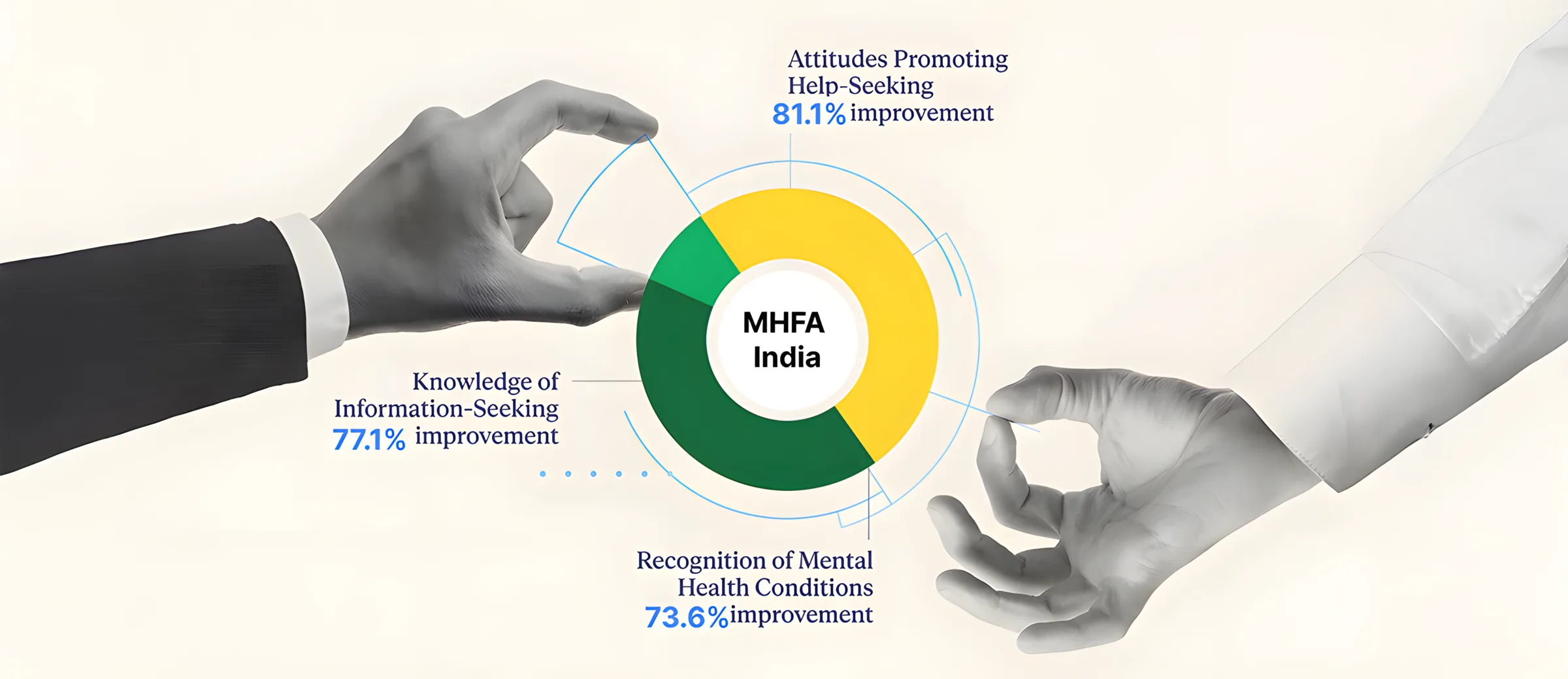
Attitudes Promoting Help-Seeking (81.1% improvement): The highest gains occurred in reducing stigma and increasing willingness to engage with mental health concerns. Participants became significantly more comfortable discussing mental health and encouraging others to seek support.
Knowledge of Information-Seeking (77.1% improvement): Participants developed strong capabilities in identifying credible mental health resources and guiding others to appropriate support services.
Recognition of Mental Health Conditions (73.6% improvement): Training substantially improved participants' ability to identify early signs of common mental health challenges.
These findings confirm that MHFA training addresses both knowledge gaps and attitudinal barriers, creating comprehensive readiness to support mental health in real-world situations.
Sustained Impact Over Time
Year-by-year analysis from 2018 to 2024 revealed consistent improvement trends across all training years. Post-training scores showed steady increases, demonstrating that MHFA training maintained effectiveness even as it scaled to reach more participants across diverse settings.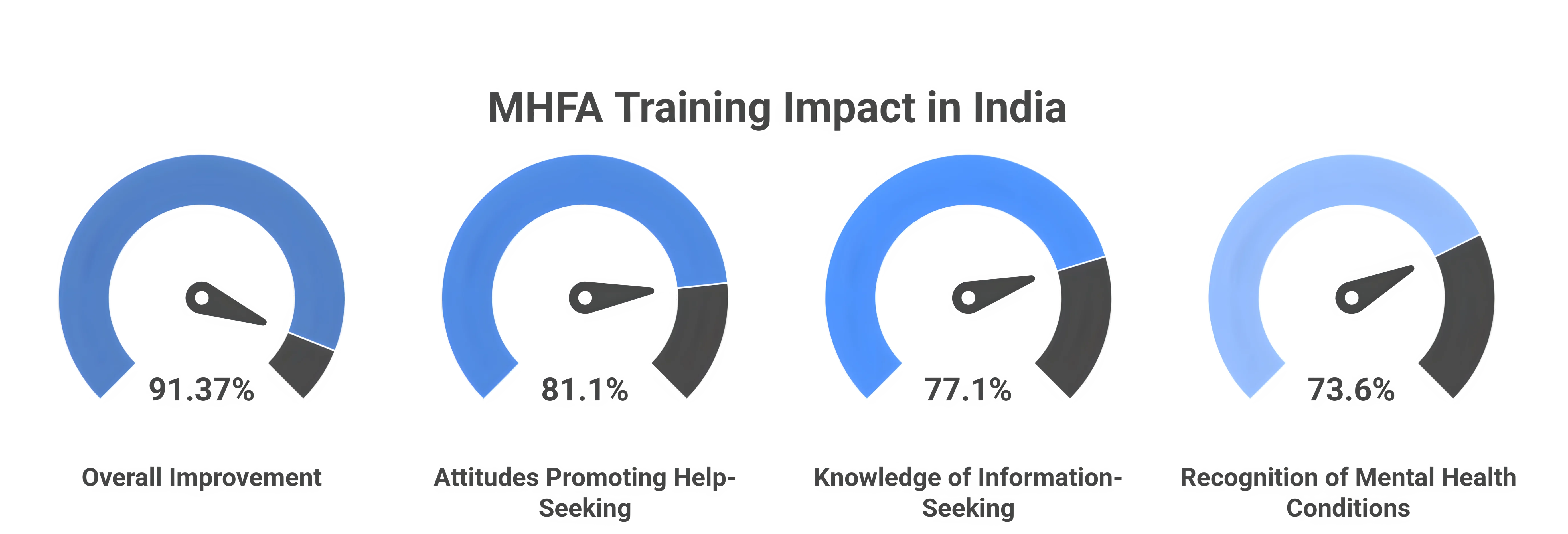
Impact Across Different Settings
Workplace Transformation
Among 1,226 workplace participants, 91.5% demonstrated improved mental health literacy. The training created notable shifts in organizational culture:
Before MHFA: Workplace mental health conversations were rare, awkward, or avoided entirely. Managers felt uncomfortable addressing team member distress. HR professionals managed crises reactively.
After MHFA: Confident peer support became normalized. Managers initiated earlier supportive conversations. Organizations developed proactive mental health cultures with clear pathways to professional resources.
The highest workplace improvements appeared in help-seeking attitudes (81.2%) and information-seeking knowledge (78.5%), creating environments where employees felt safe discussing struggles and knew how to access support.
Campus and University Impact
Student participants showed significant improvement with post-training scores increasing by an average of 10.7 points. The greatest gains appeared in help-seeking attitudes and information-seeking knowledge.
Before MHFA: Students often delayed seeking help until academic performance suffered or personal crises developed. Peer support was well-intentioned but lacked structure or knowledge.
After MHFA: Earlier help-seeking became more common. Students developed confidence to support struggling peers effectively. Campus communities built stronger safety nets with informed first responders.
Community-Level Change
Among public participants, 80.8% showed improved mental health literacy. The community group demonstrated particularly strong gains in recognizing specific mental health conditions (76.9%) and developing supportive attitudes (73.1%).
Before MHFA: Community members noticed family or neighbor distress but felt powerless to help. Cultural stigma prevented open conversations.
After MHFA: Earlier recognition of warning signs led to faster responses. Community members gained confidence to bridge the gap between distress and professional care.
The Early Intervention Advantage
The data reveals what early intervention through MHFA training actually accomplishes:
- Faster Recognition: Trained individuals identify mental health concerns earlier, when support is most effective and before situations escalate.
- Safer Conversations: Participants gain frameworks for initiating supportive discussions without fear of causing harm, making mental health conversations more natural and less anxiety-inducing.
- Timely Help-Seeking: Understanding available resources and how to access them enables trained individuals to guide others toward appropriate professional support without delay.
- Reduced Stigma: Measurable attitude shifts demonstrate that training creates more accepting, compassionate perspectives on mental health challenges.
Why This Matters for India
Mental health challenges affect millions across India, yet professional mental health resources remain limited relative to population need. MHFA training doesn't replace professional care but creates crucial first-tier support that maximizes the impact of available professional services.
By building mental health literacy across workplaces, campuses, and communities, MHFA India strengthens the entire mental health ecosystem. Trained individuals become bridges connecting people in distress with appropriate care, reducing the time between problem onset and intervention.
The evidence from 1,287 participants across seven years demonstrates that this approach works. The consistent improvements across all participant groups, training formats, and years confirm that MHFA training creates real, measurable capability to support mental health.
Next Steps
Mental Health First Aid training represents a proven approach to closing the gap between mental health awareness and effective action. The comprehensive impact data from 2018-2024 provides strong evidence that standardized, evidence-based training creates the knowledge, skills, and confidence needed for early intervention.
For organizations, educational institutions, and communities committed to supporting mental health, MHFA training offers a practical solution. It transforms concern into capability, awareness into action, and hesitation into confident support.
Every trained Mental Health First Aider represents one more person ready to recognize distress, start supportive conversations, and connect others to professional help. Across India, that's creating a movement from reactive crisis response to proactive, prevention-focused mental health support.
Ready to Build Mental Health Readiness in Your Organization?
Download the Complete Impact Report to explore detailed findings, statistical analysis, and domain-specific results from seven years of MHFA training across India. Bring Evidence-Based Mental Health First Aid Training to Your Workplace, Campus, or Community.
Our standardized MHFA programs deliver proven results in building mental health literacy, reducing stigma, and creating confident first responders who bridge the gap between distress and professional care. Schedule a Call to discuss how MHFA training can strengthen mental health support in your setting. Explore MHFA Training Programs to find the right approach for your organization's needs.
Download the Consolidated Learners Feedback Report: MHFA India Annual Report 2025.