
Tele-MANAS: Story Behind India’s 24/7 Mental Health Helpline
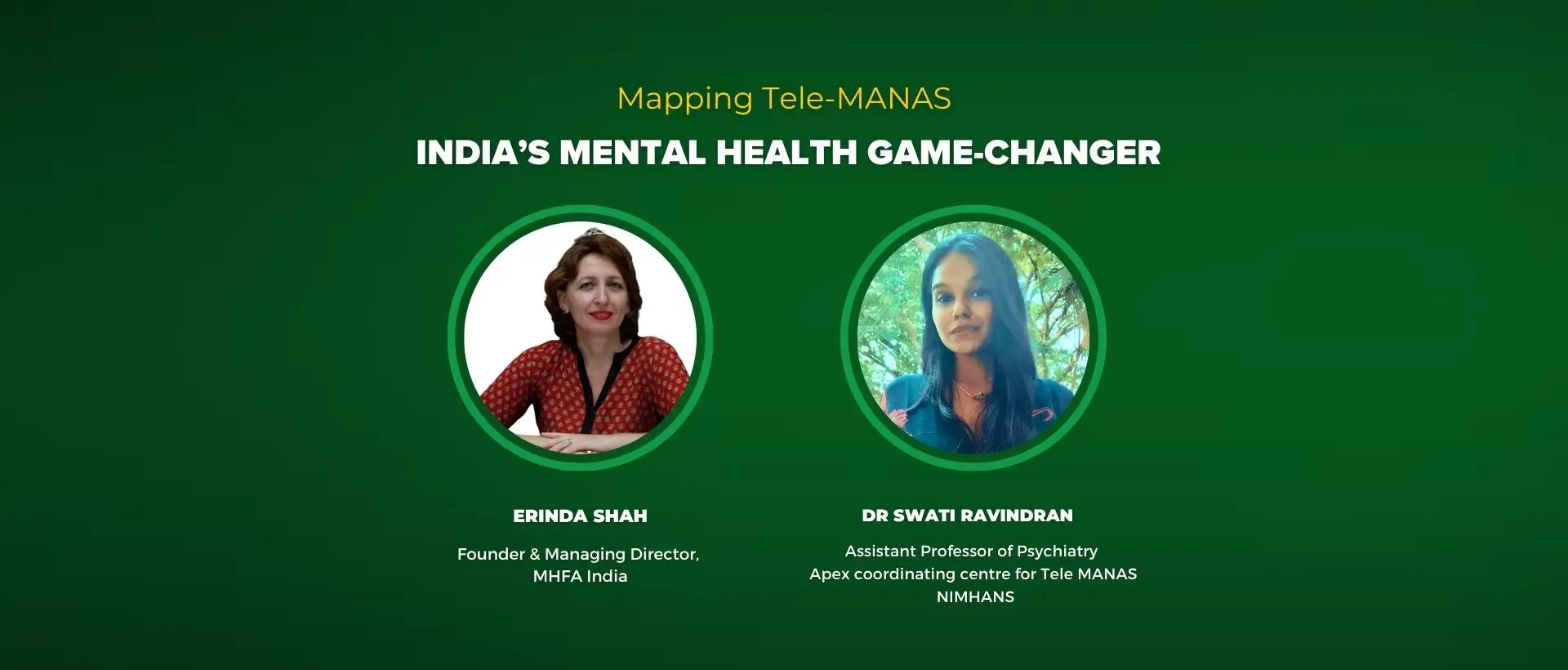 Tele-MANAS
A Live Conversation with Dr. Swati Ravindran, NIMHANS
Below are excerpts from our recent live session with Mental Health First Aid India, featuring Dr. Swati Ravindran, Assistant Professor of Psychiatry at the Apex Coordination Center for Tele-MANAS at NIMHANS. This conversation offers rare insights into how India's most ambitious mental health initiative is bridging the gap between need and access.
About the Speakers: Dr. Swati Ravindran is Assistant Professor of Psychiatry at the Apex Coordination Center for Tele-MANAS at NIMHANS, Bangalore. She has been with the program since the National Psychosocial Support Helpline launched during COVID-19 in March 2020.
Editorial Perspective
When the Union Budget 2022-23 announced Tele-MANAS, it made a bold promise: universal, equitable, and accessible mental health care for every citizen. Two and a half years later, with over 2.7 million calls answered, that promise is becoming reality.
The program operates through 53 cells across India, with over 600 trained counselors providing 24/7 support in 20 languages. But what makes Tele-MANAS unique isn't just its scale—it's the structure, rigor, and human-centered approach that Mental Health First Aid India explored in this conversation with Dr. Swati Ravindran.
The Pandemic Foundation
Erinda Shah, Founder, MHFA India: Dr. Swati, from the government’s announcement in February 2021 to Tele-MANAS going live by October — that’s just seven months. What made it possible to build something of this scale and significance so quickly?
Dr. Swati Raindra: It was built from the learnings of the COVID pandemic. The pandemic shed light on India's mental health needs in ways we'd never seen before.
I was a senior resident when NIMHANS set up the National Psychosocial Support Helpline in March 2020. We received six lakh calls during the pandemic. It gave us firsthand experience of just how pervasive mental health problems are.
Even individuals who previously would scoff at mental health issues suddenly came into the ambit of mental health. That's when we realized we needed something more structured and truly national in scale.
Editorial Insight
This pandemic origin story reflects a broader truth about mental health awareness in India. The National Mental Health Survey 2016 showed that one in seven Indians experience mental health problems, yet the treatment gap remained massive until COVID forced mental health into mainstream conversation.
What distinguishes Tele-MANAS from emergency pandemic responses elsewhere is its institutional permanence. Rather than a temporary crisis line, India built infrastructure designed to outlast the crisis that prompted it.
The Architecture of Access
Erinda: What exactly is Tele-MANAS? How does it work?
Dr. Swati: Tele-MANAS is the digital arm of India's National Mental Health Program. It's a comprehensive digital platform operating through toll-free number 14416, providing 24/7 tele-mental health services.
But it's much more than a helpline. It's a tiered system. We operate through 53 Tele-MANAS cells across India with around 600 counselors distributed across these cells.
On Access That Breaks Barriers
Tele-MANAS isn’t just a listening line. It’s a tiered healthcare system backed by clinical expertise.
| Tier | Role |
|---|---|
| Base Level – 53 Cells | 10–20 trained counselors per cell providing 24/7 support |
| Specialist Layer | Psychiatrists, clinical psychologists, psychiatric nurses |
| Mentoring Institutes – 23 Centers | Backup support when specific expertise is needed |
| Regional Hubs – 5 Zones | Coordinated escalation support |
| Apex – NIMHANS | Training, data governance, quality control |
Editorial Insight
This tiered structure responds to a long-overlooked need in India’s mental health system: accessible first-line psychological support without immediate psychiatric escalation. Most callers don’t require specialist intervention, and Tele-MANAS reflects that — nearly 90% of cases are effectively managed at the counselor level. Only about 10% need escalation to psychiatrists.
The prescription capability adds another layer of impact. With over 60% of healthcare expenses in India being out-of-pocket — even higher for mental health — Tele-MANAS reduces indirect costs like travel, daily wage loss, and time away from work, making care significantly more accessible.
The Rigor Behind the Service
Erinda: There's often skepticism about public services in India. What's the rigor behind Tele-MANAS that ensures quality?
Dr. Swati: That's exactly why we've invested so heavily in training and structure. We launched three comprehensive manuals: a course content manual with theoretical foundations, a point-of-care manual with flowcharts and case scenarios, and a trainer's manual.
Training isn't just online. There's on-site training, a learning management system platform, and accreditation of counselors. Through this process, counselors are trained to recognize what cases they can handle and what must absolutely be escalated.
But here's what really matters: every call has been a teaching experience for us. How we operated at 50,000 calls was different from 5 lakhs, and different again now. The program is built with the nature of calls coming in and the challenges we've faced.
We see this reflected in the fact that a good four-fifths of our calls are from people who call repeatedly, not just once. It's not a one-time intervention.
Editorial Insight
The repeat caller statistic is particularly telling. In a country where stigma around mental health remains high, the fact that people return again and again suggests Tele-MANAS has achieved something rare: trusted support that people actually use.
Confidentiality in the Digital Age
Erinda: Confidentiality is a major concern. Under the Mental Healthcare Act 2017, people have the right to confidentiality. How does Tele-MANAS ensure this?
Dr. Swati: This is critical, and I want to be very clear: Tele-MANAS does not record your calls. Your calls are not audio recorded.
Here’s how it works:
- Your phone number is masked. Counselors and even backend teams don’t see it unless legally authorized.
- You are assigned a unique Tele-MANAS ID, separate from your phone number.
- For every demographic question, there is a “prefer not to say” option.
- You can receive complete care without revealing your name, gender, location, or any personal identifier.
Crisis Protocols — Anonymity with Accountability
A common misconception is that anonymity might limit emergency response — especially in cases of self-harm or suicide ideation. Tele-MANAS has built a “crisis relay protocol” into its system.
- Within the first few minutes, counselors conduct a structured risk assessment.
- If there is immediate risk to life, Tele-MANAS activates district-level emergency links — connecting with local DMHP teams, police, or medical officers.
- Only the minimum necessary information is shared to enable rescue or medical support.
Dr. Swati puts it plainly:
Editorial Insight
This confidentiality framework directly tackles one of India’s biggest psychological barriers to help-seeking: fear of exposure. For many, the concern isn’t just about being unwell — it’s the fear that their story will become public narrative, whispered across neighborhoods, workplaces, and family networks.
The masked number + crisis relay model is a significant design insight: continuity without surveillance and safety without social exposure.
Breaking Barriers: Who Actually Calls?
Erinda: Who's using Tele-MANAS? Are you reaching those who need it most?
Dr. Swati: The data surprised us. The male–female call ratio has consistently held at around 45:52, and that stability over three years tells us something important—men are calling almost as much as women, which is unusual in mental health services.
But the real surprise? Rural India is calling more than urban India. We expected metros to lead. Instead, it’s villages.
This reach is possible because Tele-MANAS is embedded into existing public health infrastructure. Every Ayushman Arogya Mandir and DMHP center displays the helpline number. ASHA workers have become our human bridge.
Where there are no phones, they call on behalf of people. We’ve seen 100 calls from a single ASHA worker’s number, each for a different person in the community.
Editorial Insight
This rural penetration challenges common narratives about digital divide in India. The key isn't individual smartphone ownership. It's strategic placement of access points through existing community health infrastructure.
The ASHA worker model is particularly brilliant. India's network of community health workers provides trusted local connections that can bridge cultural, linguistic, and technological barriers aims to create at workplace and community levels.
Stories That Matter: Tele-MANAS's real-world impact
Dr. Swati: There was a family ostracized from their village because mental health issues ran in the family. They were literally living outside the village boundaries with no access to even basic resources.
One family member called Tele-MANAS. We stayed in touch for months (seven months of regular contact). We coordinated with the DMHP for home visits. Eventually, the DMHP team was able to educate the village leader about what was happening.
Two family members recovered. The third, who had a physical disability, we helped get disability certification so they started receiving financial support. Eventually, the family was brought back into the community.
That's when we realized: this is the scope of this service.
We've had multiple instances of acutely suicidal individuals reaching out. State teams coordinate with families, hostels, police, ensuring immediate safety and following up to make sure the person actually gets to the hospital.
Conclusion: Access as Action
When Tele-MANAS launched in October 2022, it was an ambitious promise. Today, with 2.7 million calls answered, it's proof that mental health care at scale is possible in India. Not someday, but right now.
What makes this conversation with Dr. Swati Ravindran so valuable isn't just the information shared. It's the invitation. An invitation to understand that seeking mental health support isn't weakness but wisdom. That public services can be trustworthy, confidential, and effective. That rural India is ready for these conversations.
Mental Health First Aid Day 2025 asks us to "Make every Conversation Matter." Tele-MANAS makes that possible. One call, one person, one story at a time.
Save this number: 14416
Because the conversation that could change everything might be just one call away.