
Bipolar Disorder in the Workplace: A Manager's Guide to Supporting Employees

Most conversations about mental health at work stay at the surface — stress, burnout, anxiety. But some conditions demand a deeper, more informed response from employers. Bipolar disorder in the workplace is one of the most pressing and least understood of them.
Bipolar disorder in the workplace is more common than most people think, more disruptive to work life than many realise, and consistently confused with mood swings, personality, or attitude. That misunderstanding has a real cost: for the individual living with it, and for the teams around them.
This guide to managing bipolar disorder in the workplace is for managers, HR professionals, and anyone who believes a mentally healthy organisation has to go beyond good intentions.
What Is Bipolar Disorder?
Bipolar disorder is a mental health condition characterised by periodic shifts in mood — and consequently, energy and activity — cycling between episodes of mania or hypomania (emotional highs) and depression (emotional lows).
During a manic episode, a person may feel unusually energised, euphoric, or irritable. They may take on too many projects, sleep very little, or make impulsive decisions. During a depressive episode, the same person may struggle to get out of bed, feel hopeless, lose concentration, and withdraw from the team entirely.
These are not character flaws or a bad attitude. They are symptoms of a medical condition, and they deserve the same empathy we would extend to any physical illness.
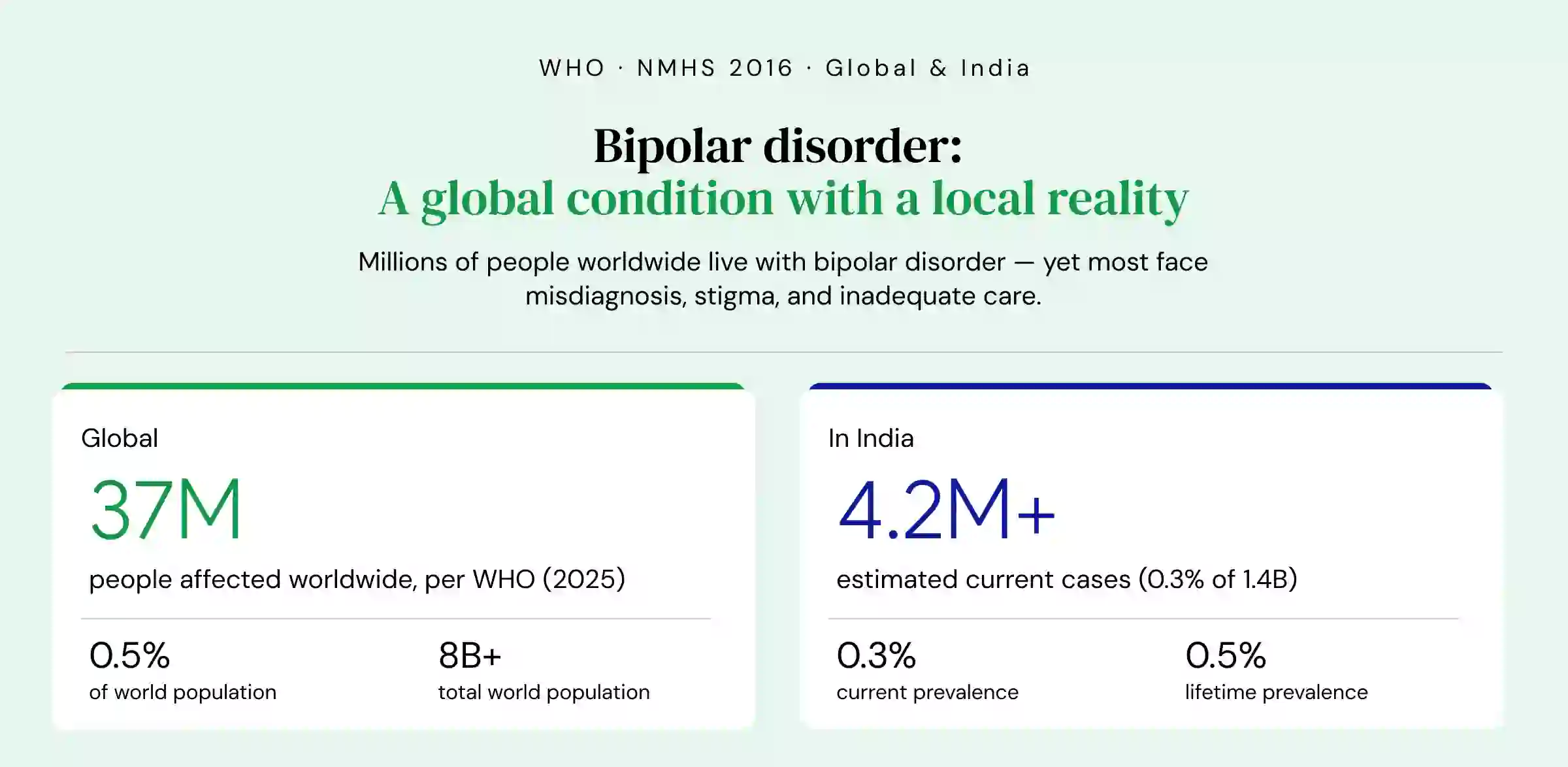
37 million people globally are estimated to live with bipolar disorder — roughly 0.5% of the world's population (WHO, September 2025).
People with the condition face widespread misdiagnosis, significant stigma, and inadequate access to treatment, especially in low- and middle-income countries. India is no exception. The National Mental Health Survey (NMHS) 2016 — one of the most comprehensive mental health studies conducted in India — found that bipolar affective disorder (BPAD) had a weighted current prevalence of 0.3% and a lifetime prevalence of 0.5% among Indian adults. In a country of 1.4 billion, those numbers represent millions of people living and working with the condition.
How Bipolar Disorder Can Affect Employees at Work
Bipolar disorder does not stay at home when someone comes to work. Its episodes shape how a person thinks, communicates, collaborates, and performs — and the effects are real and measurable.
According to the National Comorbidity Survey Replication (NCS-R) published by NIMH (USA), an estimated 82.9% of people with bipolar disorder experience serious impairment in daily functioning — the highest rate among all mood disorders. While this data is drawn from a US population, it is consistent with global findings, including evidence from India.
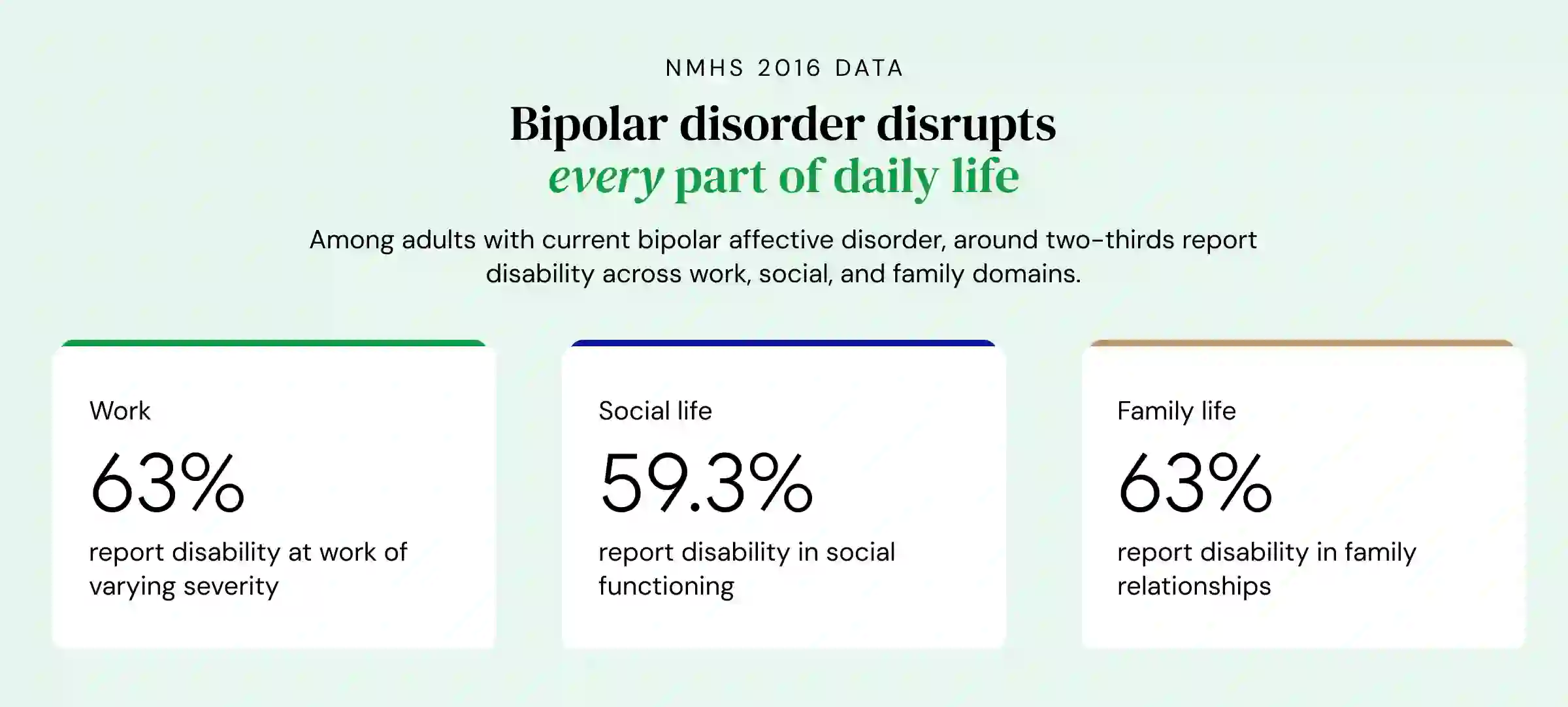
The NMHS 2016 data reinforces this: around two-thirds of those with current bipolar affective disorder reported disability of varying severity at work (63%), in social life (59.3%), and in family life (63%). That level of functional impairment makes bipolar disorder not just a personal health issue but a significant workplace concern — one that demands a thoughtful, informed response from HR and leadership.
Compounding this is India's treatment gap. Research published in the Indian Journal of Psychiatry (2023) drawing on NMHS data (Moirangthem et al., NIMHANS) found that the treatment gap for BPAD in India is large, with barriers ranging from limited mental health infrastructure to social stigma and low awareness. To understand more about India's mental health landscape and treatment gaps in 2025, the picture is complex and evolving.
This is not a performance issue. It is a medical reality — and one that workplaces are, for the most part, entirely unprepared to respond to.
Bipolar Disorder and Work Challenges
The challenges bipolar disorder creates at work are cyclical, unpredictable, and often invisible to those around the person experiencing them. To understand the full picture, it helps to look at what each phase looks like in practice.
| Manic / Hypomanic Phase | Depressive Phase |
|---|---|
| Euphoria or irritability | Low mood, hopelessness |
| High energy, reduced need for sleep | Fatigue, difficulty getting up |
| Overcommitment to projects | Missed deadlines |
| Impulsive decisions | Difficulty concentrating |
| Rapid speech, racing thoughts | Withdrawal from team |
| Appears unusually productive or enthusiastic | Increased absenteeism |
Neither extreme is a reflection of the person's character, capability, or commitment. Both are clinical symptoms.
A 2024 paper published on ResearchGate (Current Challenges and Indian Perspectives in the Diagnosis and Management of Bipolar Disorders) highlights the added complexity in the Indian context: frequent comorbidities, significant gaps in early identification, and the challenge of managing the condition with limited mental health infrastructure. Many employees living with bipolar disorder in India have never received a formal diagnosis, which means they are navigating these challenges without a name for what they experience — and without any professional support.
The result is a workforce that is silently struggling, and workplaces that interpret those struggles as attitude, unreliability, or lack of motivation. Understanding this distinction is foundational to the kind of workplace support that genuinely helps employees with mood disorders.
How to Approach Employees Showing Signs of Bipolar Disorder
1. Recognise the signs without diagnosing
Before anything else: a manager's role is not to diagnose. It never will be. Diagnosing bipolar disorder is a clinician's responsibility — not HR's, and not a manager's.
What managers can do is notice patterns. They are often the first to observe a change in behaviour. Look for patterns, not isolated incidents: fluctuating productivity, erratic communication, sudden overcommitment followed by complete withdrawal, or increased absenteeism are all signals worth paying attention to. The goal is not to label — it is to notice, and then to ask with empathy, not judgement.
2. Have a conversation, not a confrontation
When approaching an employee you are concerned about, choose a private, calm setting. Focus on observable behaviour and its impact on work, not on mood or personality. If the employee chooses to disclose a diagnosis, listen, acknowledge, and assure them that the organisation is there to support them. Do not minimise. Do not project.
3. Build structure, flexibility, and space to recover
Routine and predictability can help people with bipolar disorder maintain stability — but this applies most when they are in recovery and able to function. Clear expectations, regular check-ins, and consistent workflows reduce uncertainty and support sustained performance during stable periods.
During acute episodes, however, the priority shifts. Employees may not be in a position to work effectively, and the most supportive response is to offer space for treatment and recovery — not task adjustments that assume continued functioning. Flexibility serves two distinct moments: during recovery, to ease the return to work without pressure; and after recovery, to support reintegration with manageable responsibilities.
4. Build a culture of psychological safety
Employers need to foster a culture where employees can discuss their challenges without fear of stigma. That means training managers to respond with empathy, normalising mental health conversations across the organisation, and making it clear that mental health conditions — including bipolar disorder — are treated with the same dignity as any physical health issue.
5. Connect employees with professional support
Bipolar disorder requires clinical management: medication, therapy, and consistent psychiatric follow-up. Managers are not equipped to fill that role. What employers can do is ensure employees know about and can access the support available — whether that is an Employee Assistance Programme, mental health leave, or referral pathways to professional care. Flexible scheduling to accommodate therapy appointments or medical visits is also a practical, meaningful workplace accommodation.
How Can Organisations Support Employees With Bipolar Disorder?
Supporting an employee with bipolar disorder is not about making exceptions. It is about building a workplace where people can function, stabilise, and return to meaningful work — without being penalised for having a medical condition.
1. Flexible work arrangements
Rigid schedules work against a cyclical condition. Flexible hours, hybrid options, and adjustable workloads during difficult periods are not special treatment — they are what allows an employee with bipolar disorder to stay in the workforce at all. These are core reasonable accommodations for bipolar disorder recognised under the RPWD Act.
2. Clear communication and regular check-ins
Unclear expectations are destabilising. Brief, consistent one-on-ones focused on workload and wellbeing — not performance review — give managers an early signal when something has shifted, and give employees a space to say so before things escalate.
3. Mental Health First Aid training and awareness
Most managers want to help — they just do not know how. Mental Health First Aid training equips them to recognise early signs, respond without judgement, and connect colleagues to the right support before a situation escalates. It is one of the most evidence-backed workplace mental health programmes available to organisations in India today.
4. Reasonable accommodations
Adjusted workloads during acute episodes, temporary reassignment of high-stakes tasks, and phased returns after recovery. These should be time-limited, practical, and decided with the employee — not for them.
5. Access to professional care
Access to mental health services and helplines should be visible and accessible to all employees — not just those who have disclosed. Flexible scheduling for therapy or psychiatric appointments costs very little and means a great deal.
6. Encouraging a healthy work-life balance
Always-on cultures actively worsen bipolar disorder and fuel workplace stress and anxiety across the board. Protecting rest, modelling sustainable work habits, and not rewarding overwork are protective — for everyone, not just employees with a diagnosis.
7. Supportive leadership
Policies do not create psychological safety — people do. When leaders respond to disclosure with empathy rather than discomfort, and check in without waiting for a visible crisis, employees feel safe enough to ask for help before things fall apart.
How Does the Law Protect People With Bipolar Disorder at Work?
The Rights of Persons with Disabilities Act, 2016 (RPWD Act) explicitly includes mental illness — including bipolar disorder — as a recognised disability.
What must employers do?
Companies with 20 or more employees must have an Equal Opportunity Policy in place and must provide reasonable accommodations for employees with disabilities, including those with mental health conditions.
Can an employer discriminate based on bipolar disorder?
No. The RPWD Act prohibits discrimination in hiring, promotion, and termination on the basis of disability. This protection extends to mental illness.
Does legal protection mean employees are actually safe?
Not automatically. Rights are only meaningful when employees know them, feel safe to disclose, and work in organisations that live their values — not just list them in a policy document. Building that environment is the real work. Understanding the full context of mental health policy and practice in India in 2025 helps set realistic expectations about what legal protection means on the ground.
How MHFA Supports People With Bipolar Disorder in the Workplace
It is important to be clear about what Mental Health First Aid is and what it is not.
MHFA is not a substitute for clinical treatment. It does not train participants to diagnose bipolar disorder, prescribe medication, or manage psychiatric episodes. That is the role of trained mental health professionals.
What MHFA does is equip managers, HR professionals, and colleagues with the awareness to recognise the early signs of a mental health challenge, the skills to respond with confidence and care, and the knowledge to connect the individual to appropriate professional support before a difficult situation becomes a crisis.
In a condition like bipolar disorder — where early identification and timely intervention make a meaningful difference to outcomes — that first-responder capacity within a team is genuinely valuable. An MHFA-trained colleague does not pathologise. They show up. To understand the difference between what MHFA offers and what clinical counselling provides, read our guide on counselling vs Mental Health First Aid.
MHFA India offers an internationally recognised, 12-hour online training programme that builds this capacity across organisations — from front-line managers to senior leadership. Just as physical first aid prepares us to act before an ambulance arrives, Mental Health First Aid prepares us to show up before a colleague in distress falls through the cracks.
Equip your managers with the skills to recognise and respond to mental health challenges at work — including bipolar disorder.
Conclusion
Bipolar disorder in the workplace is not a productivity problem. It is not a behaviour issue. It is a serious medical condition that affects millions of working adults in India — often in silence, often without a diagnosis, and often without any meaningful support from the organisations they give their time to.
The NMHS 2016 data shows that the treatment gap is wide. The functional disability is real. And most organisations remain entirely unprepared to respond to bipolar disorder in the workplace — not because they do not care, but because they have never been equipped to. That is exactly the gap that workplace mental health investment — and Mental Health First Aid training in particular — is designed to close.
Sources
- World Health Organisation (WHO). Bipolar Disorder Fact Sheet. September 2025.
- Moirangthem S, et al. (NIMHANS). Bipolar Affective Disorder in India: A Multi-site Population-Based Cross-Sectional Study. Indian Journal of Psychiatry, December 2023.
- Ministry of Health and Family Welfare, Government of India / NIMHANS. National Mental Health Survey of India, 2015–16.
- ResearchGate. Current Challenges and Indian Perspectives in the Diagnosis and Management of Bipolar Disorders. December 2024.
- National Institute of Mental Health (NIMH), USA. Bipolar Disorder Statistics — National Comorbidity Survey Replication (NCS-R).
- American Journal of Managed Care. Impact of Bipolar Disorder in Employed Populations. November 2008.
Frequently Asked Questions (FAQ's)
How does bipolar disorder affect people at work or keeping a job?
Bipolar disorder disrupts consistency. Manic phases can lead to overcommitment and erratic decisions, while depressive phases make even basic tasks feel impossible. Employees with bipolar disorder miss nearly 19 workdays a year on average, according to the American Journal of Managed Care.
How do I identify a colleague with bipolar disorder?
You can't, and you shouldn't try. That's a clinician's job. What you can do is notice patterns — big swings in energy, productivity, or communication — and check in with empathy, not a diagnosis. That’s where Mental Health First Aid comes in.
How has disclosing bipolar disorder to an employer hurt people?
Many report being sidelined, passed over for promotions, or treated as unreliable after disclosure. Fear of stigma is real — which is why most people manage their condition in silence instead of asking for the support they need.
Why is maintaining a job so hard for people with bipolar disorder?
Most workplaces demand consistency. Bipolar disorder is cyclical by nature. That mismatch compounded by stigma, a large treatment gap in India, and limited workplace awareness makes sustained employment genuinely difficult without the right support.
What does bipolar disorder look like in the workplace?
In a manic phase: Euphoria/ irritation, high energy, overcommitment, impulsive decisions, reduced sleep. In a depressive phase: low mood, missed deadlines, withdrawal, difficulty concentrating, increased absenteeism. Neither reflects character — both are symptoms.
What are workplace accommodations for bipolar disorder?
Flexible hours, adjusted workloads during difficult periods, regular check-ins, access to professional care, and a culture where employees feel safe enough to ask for help without fear of judgment.