
Mental Health Is Now the World's Biggest Health Concern: What the Ipsos 2025 Report Reveals

For as long as anyone can remember, when one spoke of the greatest health threats in the world, it was always related to cancer, obesity, and other chronic diseases. By 2025, however, everything changed, and there is proof in the form of the Ipsos Health Service Report 2025.
As an important 30-country global survey of more than 23,000 people, the findings indicate that the mental health of the world's population is now the number one health issue, surpassing even cancer.
For an organization like Mental Health First Aid India, this data confirms what we have seen on the ground: the fact that mental health is now the number one health threat should come as no surprise at all.
Mental Health Overtakes Cancer: What the 2025 Global Data Shows
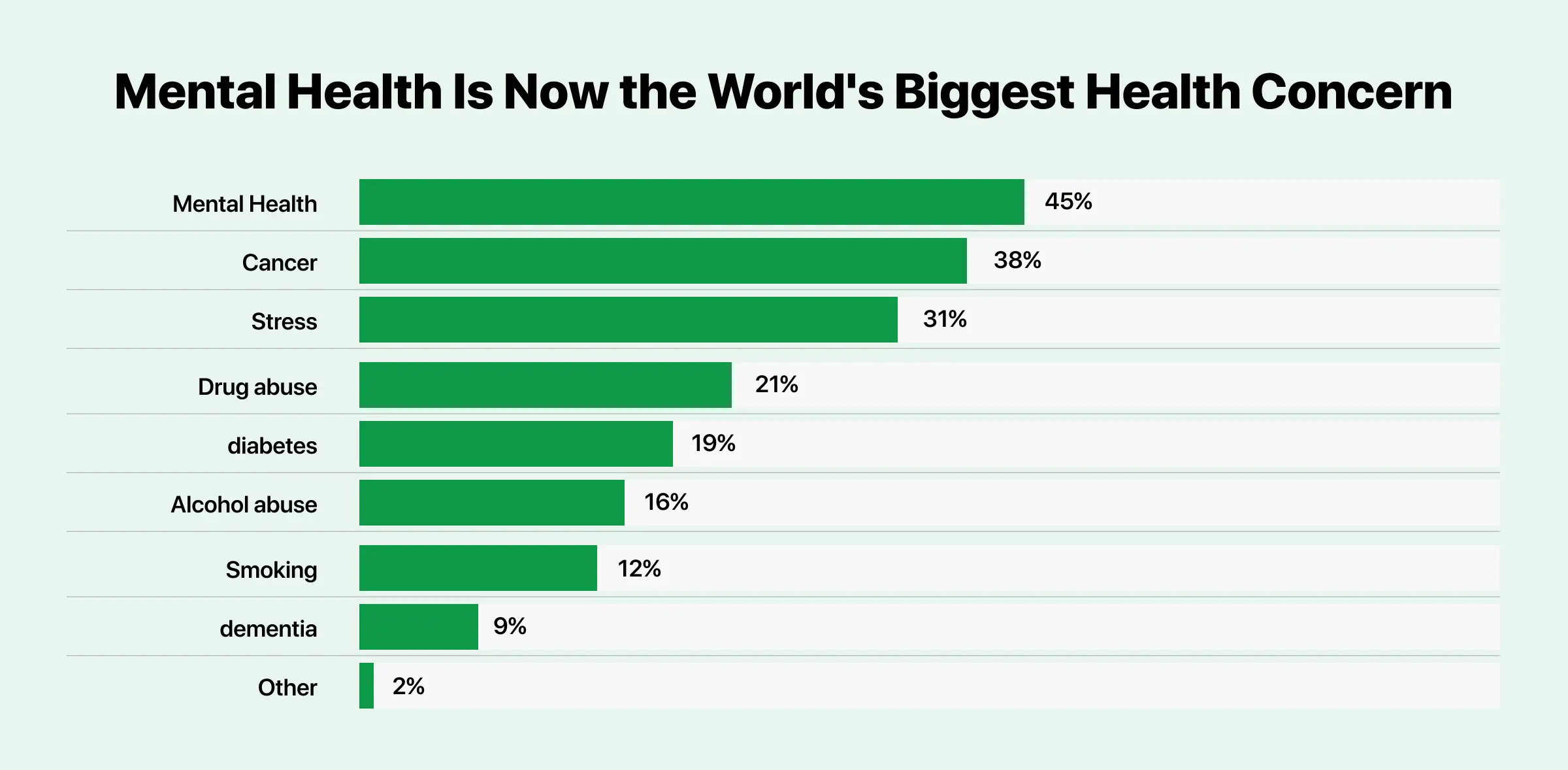
The numbers from the Ipsos 2025 report tell a clear story about how quickly things are changing. Mental health is now the biggest health issue in 30 countries. It is mentioned by 45% of people around the world, more than cancer (41%), stress (31%), and obesity (25%).
Only 27% of people in the countries that Ipsos surveyed in 2018 said that mental health was a major issue. That number has gone up by 18 percentage points in just seven years, which is the biggest increase of any health issue tracked in the study.
Chile is the country with the most people (68%) who say mental health is their biggest health concern, followed by Sweden (63%), Australia (62%), and Spain (62%) . Japan (25%), Romania (21%), and Hungary (28%) are at the bottom, but their numbers are still much higher than they were in 2018.
At the same time, the worry over obesity dropped significantly, coming down to 25% internationally. Mankind has not ceased its worry about sicknesses, but what may be new in this respect is the realization that the mental wellbeing of man is no less threatened than his physical health.
Key global statistics at a glance:
- 45% of people globally identify mental health as the top health concern (up from 27% in 2018) rank it above cancer (41%), stress (31%), and obesity (25%).
- 76% say mental and physical health are equally important.
- 38% feel their healthcare system actually treats mental and physical health as equally important.
The Reality of India’s Mental Health Transition
Although the global average is significant, India’s trajectory stands out as one of the most alarming among all nations included in this research study. In 2018 only 18% of Indians considered mental health issues a priority in relation to other diseases and illnesses. However, by 2025, the percentage increased up to 52%, meaning a staggering rise of 34 percentage points in just seven years that places India well above the global average.
This sharp increase is not simply a sign of rising awareness, though awareness has certainly grown. It reflects a real and growing burden on Indian society associated with the economy, the pace of urbanization, the unresolved psychological fallout of the pandemic, and the weakening of social structures.
What makes India's situation even more troubling is the widening gap between need and capacity. According to the Ipsos report, 26% of Indians have discussed their mental state with a general practitioner, which is the highest percentage among all nations examined in this research. Also, 25% of respondents had taken days off from work or school to help a family member experience mental difficulties. These figures expose a system under severe strain rather than one functioning effectively.
These statistics tell us a lot. The Indians have stopped suffering in silence. However, while being willing to speak out is one thing, it does not mean that they have all the resources available to take action. The willingness to seek help means nothing when the infrastructure to provide that help is dangerously inadequate. This is one of the biggest problems we need to address.
Why Mental Health Issues Are Rising in India: Three Root Causes
The increase in mental health problems cannot be attributed to a single issue in India or worldwide. From the information given in Ipsos 2025 study, there are converging issues contributing to the rise of mental illnesses:
1. The Impact of COVID-19 on Mental Health
The outbreak of the coronavirus altered the discourse around mental health. The shared experiences of being locked up at home, losing friends and family members to the virus, as well as other negative experiences contributed to a change in people's perspectives regarding the importance of taking care of mental wellness. The pandemic ensured that everyone experienced some form of anxiety and depression, making mental health awareness mainstream.
2. Financial Instability and Mental Health Issues
There is a strong correlation between financial health and mental health. High inflation rates, unemployment, and increased cost of living can contribute significantly to mental problems. When an individual's basic requirements are affected by financial instability, mental health deteriorates.
3. The Parity Gap in Healthcare
There exists a striking paradox in the global attitude towards healthcare. When 76% of respondents worldwide consider mental and physical well-being to be of equal importance, 38% believe that the respective healthcare system gives equal priority to them. Even lower in India, only 35% of Indians are confident that their country’s healthcare gives equal consideration to mental well-being. This parity gap leads to a situation where despite the understanding that people need help, they lack access to such services.
➡️ Related: India’s Mental Health Landscape in 2025: Ground-Level Insights
Stress and Depression in India: What the Numbers Reveal
There are two illnesses underpinning the overall concern regarding people's mental health – these are stress and depression.
Globally, 59% of respondents say that in the previous year there were occasions when they experienced stress so severe that they could not cope with it. Further, 27% say that the stress caused them to take days off from work. In India, employees' work absence owing to stress is quite frequent; indeed, according to Ipsos data, India ranks first worldwide in terms of stress causing employees to stay away from work.
Similarly, the findings on depression are no longer alarming. Globally, 27% of individuals claimed to have had long periods of sadness or hopelessness for two weeks or more. The statistic is worse in India where the number stands at 31%, thus making India the leader in the world statistics for depression cases.
Such figures cannot be considered an aberration in any way. When close to a third of Indians admit to feeling sad or hopeless, it no longer remains a minority problem but a major health crisis.
The Mental Health Action Gap: Why Awareness Alone Is Not Enough
Maybe the most significant and least reported result from the Ipsos 2025 report relates to how people act or rather do not act when they are struggling.
Asked about what they did in response to feeling mentally unwell within the previous year, 41 percent of people around the world stated that they did not undertake any of the mentioned activities. They did not talk to doctors, counselors, friends, or relatives. They did not have days off, did not consume medications, or did not even use the internet. In other words, they just didn't do anything.
This is an action gap, and it is where all the difficulty resides. People get more aware of their problem. They are more prone to calling it a mental health problem than before. However, turning that awareness into concrete behavior is another matter entirely.
Why? The reasons are clear from the literature: stigma, confusion about where to go, the price tag on seeking treatment from a professional, the judgment factor, and our medical system, which, as evidenced by the statistics, still sees mental wellness as a secondary issue. However, there is one reason for not seeking help that does not get as much attention: a lack of someone around who can provide help.
What Is Mental Health First Aid and Why India Needs It Now
This is where Mental Health First Aid becomes really important.
Most of us know what to do if someone collapses at work or gets a cut. We use first aid. We know how to apply pressure, call for help and keep someone calm until professionals arrive.If someone at work, school or in our family is clearly struggling with their mental health, . like withdrawing, crying or feeling hopeless, most of us don't know what to do next.
Mental Health First Aid training fills that gap. It's not about turning people into therapists. It gives people a clear, caring and proven way to respond to someone in mental distress. It teaches how to start a conversation, listen without judging, know when to suggest help and how to stay supportive during a crisis.
In the context of the 2025 data, the case for MHFA is compelling on multiple levels:
Closing the action gap: 41% of people do nothing when they're struggling. People trained in Mental Health First Aid become the bridge between distress and support. They're the one who notices, asks and stays.
Early intervention saves lives: Trained individuals can spot warning signs like withdrawal, mood changes or expressions of hopelessness before things get worse.
Reducing stigma through conversations: By making mental health discussions normal in workplaces and communities Mental Health First Aid breaks the silence that stops people from seeking help.
Addressing Indias workplace mental health emergency: India has an alarming number of stress-related absenteeism globally. Trained managers are not just kind; they're essential for an productive workplace.
Reaching where healthcare can't: 35% of Indians think mental health is treated equally in healthcare. Community-level first response isn't an addition to professional care; in many cases it's the first and most accessible support available.
Building a Mental Health-First Culture in India
The Ipsos 2025 report represents a turning point not just in data, but in public consciousness. The era when mental wellness was considered personal shame or the concern of medical professionals exclusively is slowly coming to an end. The future, meanwhile, will be determined by our actions today.
The creation of a culture that values mental wellness above all else will not have to wait for systemic changes, although we must keep advocating for those. It will require us to take some more immediate steps.
- Mental Wellness into Everyday Life: Ask how someone is feeling psychologically as often as you ask about their physical well-being.
- Awareness to Action: The data shows us clearly that awareness alone is inadequate. We must acquire the necessary skills.
- Community Mental Health Networks: India should not rely on the work of few psychologists and psychiatrists only. Mental first responders must be present everywhere – in the offices, schools, residential complexes, etc.
- Parity: Keep advocating for equal treatment of mental and physical health in healthcare services and institutions.
In other words, the debate on the importance of mental well-being has been settled; the question is whether we are prepared to address it.
➡️Related: India’s Mounting Mental Healthcare Expenses: A Call for Action
Conclusion
The Ipsos Health Service Report 2025 is a wake-up call. Mental health is the defining health challenge of the current era affecting nearly one in two people in India, affecting almost half of the population, causing unprecedented levels of absenteeism at workplaces, and placing an unprecedented burden on healthcare systems not equipped to handle such demands.
Awareness is not enough. Action is what the moment demands. And one of the most powerful actions any individual can take right now, without waiting for policy change or institutional reform is to become trained in Mental Health First Aid.
It is everybody’s responsibility. The real question is not whether mental health matters or not, but rather whether we are ready for it or not.
Frequently Asked Questions (FAQ's)
Why is mental health now a bigger concern than physical illnesses like cancer?
Cancer is still one of the biggest dangers that we are facing today. However, there has been progress in medicine and technology, making people more likely to survive cancer physically and be confident about this. Unfortunately, at the same time, mental disorders have become very common because of numerous stressors worldwide.
What has been the evolution of India’s attitude toward mental well-being?
India has recorded one of the sharpest increases in interest worldwide, with levels rising from 18% in 2018 to 52% currently. While mental well-being awareness has never been higher, affordable treatment remains challenging due to the realization-action gap that India suffers from.
Define the "action gap," and explain its significance.
The action gap entails the 41% of respondents who have experienced mental distress yet have done nothing about it. It is critical, since intervention plays a vital role in restoring the patient back to good health. Delaying action until a crisis point may overwhelm the person and the healthcare system.
Why is Mental Health First Aid (MHFA) important?
Mental Health First Aid offers the tools necessary to close the action gap. It equips the trainees with skills such as approaching the person in question, listening empathetically, providing information/reassurance, and encouraging professional help when necessary. MHFA is the "CPR" of the mind.
Can MHFA training actually reduce workplace absenteeism?
Yes. By training employees and managers to recognize signs of stress and burnout early, organizations can support staff before they require long-term sick leave. This improves retention, morale, and overall productivity.
Is mental health treated equally to physical health in India?
According to the Ipsos 2025 study, only 35% of Indians feel that mental and physical health are treated with equal priority by the healthcare system.
Who should take an MHFA course?
Everyone. Just as anyone can learn physical first aid, anyone, regardless of their professional background, can learn to be a Mental Health First Aider. It is especially critical for those in leadership, education, and HR roles.
What is the most common driver of mental health concern today?
Stress is the primary driver. The Ipsos 2025 study shows that 59% of people have felt so stressed they couldn't cope, often driven by the "perfect storm" of pandemic recovery, economic instability, and the pressures of modern, digitally-connected life.
Why is depression ranking so high in India specifically?
India ranks highest globally for people reporting prolonged periods of sadness (31%). This is likely due to a combination of increased awareness and reporting.
What can I do if I belong to the 52% who worry about mental health?
Education will be the first step in this direction. Transitioning from “worry” to “preparation” begins with acquiring the skills required to spot and address mental health issues, whether for oneself or for others, through programs such as MHFA.