
Making Conversations Matter: MHFA Day 2025 - Stories From MHFAiders
 MHFA Day
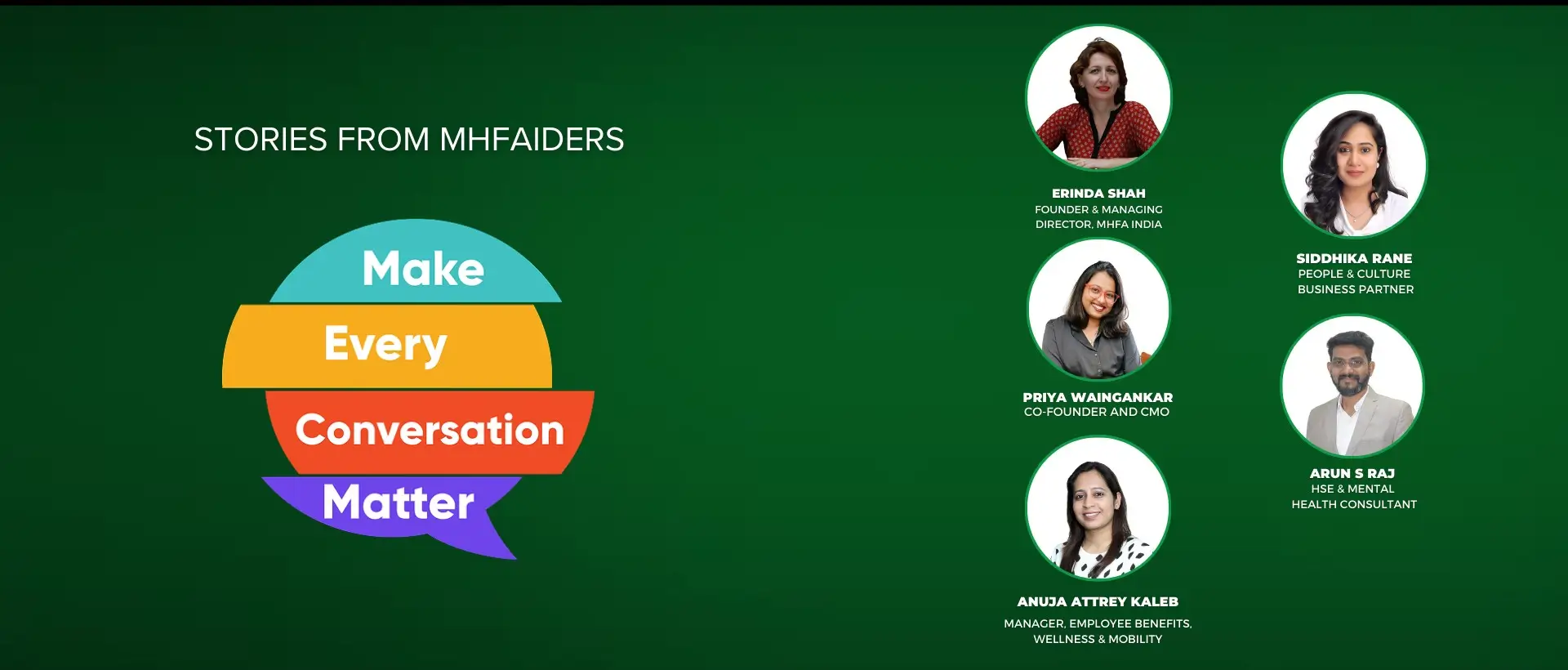
Below are excerpts from our MHFA Day live session, featuring certified Mental Health First Aid practitioners sharing their journeys, challenges, and the transformative power of meaningful conversations in mental health support.
This session captures authentic voices from the frontline of mental health advocacy in India, offering insights into how individual transformation creates ripple effects across workplaces, families, and communities.
Editorial Perspective
The theme for Mental Health First Aid Day 2025 is clear: "Make the Conversation Matter." But what does this actually look like in practice? In India, where mental health conversations are still breaking through decades of stigma and cultural barriers, the answer lies with practitioners who've learned to navigate these waters with skill, empathy, and courage.
Recent data from the National Mental Health Survey shows that while mental health awareness has increased by 40% in urban India since 2020, the gap between recognition and action remains significant. The voices we hear today represent those bridging that gap—one conversation at a time.
MHFAIders
Erinda Shah – Founder & Managing Director, MHFA India
Host of this MHFA Live session, leading the conversation on what inspires people to become certified Mental Health First Aiders.
MS. Priya Waingankar leads employee experience at Crew Tangle, a brand marketing agency, where she integrates mental health support into company culture and client relationships.
MS. Siddika Rane serves as People & Culture Business Partner at Breny, an Australian company, bridging international mental health practices with Indian workplace realities.
MS. Anuja Attrey Kaleb is an HR leader specializing in global mobility and employee benefits, uniquely certified in both physical and mental health first aid.
MR. Arun S Raj combines 20 years of industrial safety expertise with mental health consulting, addressing the intersection of psychological wellbeing and workplace safety.
Editorial Insight
The diversity of backgrounds here reflects a crucial trend: mental health support is no longer confined to clinical settings. From marketing agencies to industrial safety, HR leadership to international business partnerships, MHFA training is creating a distributed network of support across India's professional landscape.
Research published in the Indian Journal of Occupational Health (2024) shows that workplace mental health interventions are 60% more effective when delivered by trained colleagues rather than external consultants alone. These practitioners represent that peer-to-peer support model in action.
The Power of Personal Transformation
Erinda: This year's theme is "Make the Conversation Matter." Can you share a conversation that changed everything, either for you or someone you helped?
Arun: The most significant change has been in my listening skills. My family always told me I wasn't a good listener, especially at home. But after MHFA training, this completely transformed. I apply MHFA principles in my everyday life—whether with colleagues, friends, or even strangers I meet while travelling. I’ve realized that people often open up during such moments, sometimes because they feel safe sharing with someone they may never see again. MHFA has helped me listen without judgment and offer support in those situations.
Priya: For me, it was recognizing that my own mental health journey could become a strength rather than a weakness. When I started sharing appropriately with my team about the importance of mental health, it created this ripple effect. People began having conversations they'd never had before.
Siddika: What struck me was how theoretical knowledge translated into real-world application. Every conversation I have now, whether at work or personally, I approach differently. I'm more aware of the signs, more patient with the process, and more confident in guiding people toward resources.
Editorial Insight
This personal transformation aspect aligns with findings from the International Association for Healthcare Communication (2023), which found that healthcare and wellness training creates a "practitioner effect", where the act of learning to help others simultaneously improves one's own emotional intelligence and interpersonal skills.
The ripple effect Priya mentions is particularly significant in Indian workplaces, where hierarchical structures often mean that leadership vulnerability can permit others to be open about their own struggles.
Workplace Applications
Erinda: How has your MHFA training changed your approach in professional settings?
Anuja: In HR, you're often the first person people come to when something's wrong. Before MHFA training, I might have immediately jumped to solutions or policy responses. Now, I listen first, create psychological safety, and help people process what they're experiencing before moving to action steps.
Siddika: Working with an Australian company gave me perspective on how different cultures approach mental health. The training helped me bridge that gap—understanding when to apply global best practices and when to adapt to Indian cultural contexts in these conversations.
Arun: In industrial settings, mental health and physical safety are interconnected. When someone's stressed or dealing with personal issues, it affects their attention, decision-making, and ultimately workplace safety. MHFA skills help me identify these situations before they become safety incidents.
Editorial Insight
The workplace applications these practitioners describe reflect broader shifts in Indian corporate culture. A 2024 study by the Indian Institute of Management found that companies with trained mental health first aiders reported 35% fewer stress-related absenteeism and 28% improvement in team psychological safety scores.
Arun's connection between mental health and physical safety is particularly relevant for India's manufacturing and industrial sectors, where workplace accidents often have underlying psychological factors.
Breaking Cultural Barriers
Erinda: What's the biggest challenge you've faced in making mental health conversations matter in the Indian context?
Priya: The biggest challenge is the "strength" narrative, the idea that acknowledging mental health struggles means you're weak or incapable. In business especially, there's this pressure to always appear in control and successful.
Siddika: Language and cultural sensitivity are huge. What works in Australia doesn't always translate directly. I've learned to read between the lines more, understand when someone is sharing in indirect ways, and respect cultural boundaries while still providing support.
Anuja: Family dynamics often come into play. Someone might be ready to address their mental health, but family pressure or expectations create additional barriers. Sometimes the conversation includes helping people navigate those family conversations too.
Arun: In industrial settings, there's often a "tough it out" mentality. Mental health can be seen as luxury or weakness. I've learned to frame these conversations around performance, safety, and practical outcomes rather than purely emotional wellness.
Editorial Insight
These cultural challenges reflect findings from the National Institute of Mental Health and Neurosciences (NIMHANS) 2024 report, which identified family expectations and workplace "strength culture" as the top two barriers to mental health support seeking in professional Indians aged 25-40.
The practitioners' adaptive approaches reframing conversations around performance and safety, developing cultural sensitivity, working within family systems—demonstrate the evolution of mental health support beyond Western-derived models.
Managing own Mental Health
Erinda: How has this journey changed you personally, beyond the workplace?
Arun: My family relationships have completely transformed. My wife and children now say I'm actually present when they talk, not just physically there. This has improved our communication and deepened our connections significantly.
Priya: I've become more patient with myself and others. When my team sees me modeling self-compassion and healthy boundaries, it gives them permission to do the same. It's created this culture where taking care of mental health isn't seen as selfish—it's seen as responsible.
Siddika: I'm more aware of my own mental health patterns and triggers now. I can recognize when I need support and actually ask for it, which was something I struggled with before.
Anuja: Having both physical and mental health first aid training has given me this unique perspective on holistic wellbeing. I see the connections between physical health, mental health, workplace stress, and life satisfaction much more clearly now.
Editorial Insight
This personal transformation aspect reflects what researchers call the "helper therapy principle"—the idea that the act of helping others can be therapeutic for the helper. A longitudinal study by the Indian Psychology Association (2024) found that MHFA practitioners showed significant improvements in their own stress management, emotional regulation, and relationship satisfaction within six months of certification.
Looking Forward: Making Every Conversation Count
Erinda: What's your message for people who want to make conversations matter but don't know where to start?
Priya: Start with yourself. Get comfortable talking about mental health in your own life first. When you can model that openness and self-awareness, others feel safer opening up to you.
Siddika: Listen more than you speak. Really listen. Don't try to fix or solve immediately. Sometimes people just need to feel heard and validated.
Anuja: Don't underestimate the power of checking in. A simple "How are you really doing?" can open doors you never expected. But be prepared to follow through with support if they share something significant.
Arun: Remove judgment completely. People can sense when you're judging them, and it shuts down authentic conversation immediately. Create that non-judgmental space, and you'll be amazed what people will share.
Key Takeaways
- Personal experience drives purpose: Each Aiders' journey began with recognizing mental health needs in their immediate environment.
- Professional diversity strengthens impact: Mental health support works best when integrated across all workplace functions, not isolated in HR or medical departments.
- Cultural adaptation is essential: Effective mental health conversations in India require understanding family dynamics, cultural expectations, and communication styles.
- Listening transforms relationships: Enhanced listening skills improve both professional effectiveness and personal relationships.
- The helper heals too: Learning to support others' mental health simultaneously improves one's own emotional intelligence and wellbeing.
- Small conversations create big changes: Regular check-ins and non-judgmental presence can be more powerful than formal interventions.
Mental Health First Aid Day 2025: Make the Conversation Matter
Every conversation has the power to change a life. Every trained practitioner creates ripples of support that extend far beyond their immediate circle. In a country where mental health conversations are still finding their voice, these practitioners are proof that change happens one authentic conversation at a time.
Watch the complete MHFA Day conversation to hear more insights about making mental health conversations matter in Indian workplaces and communities. For information about Mental Health First Aid certification, visit.