
Digital Detox and Mental Health: Why Unplugging Is Harder in India

Pick up your phone. Check the time. Open WhatsApp. Scroll Instagram. Switch to news. Back to WhatsApp. That loop, repeated dozens of times a day, is not personality quirk. It is a pattern now, characterising the daily lives of hundreds of millions of Indians and quietly reshaping the country's mental health landscape.
As of early 2025, India had 806 million internet users and 491 million social media user identities, representing 33.7% of the total population (DataReportal, 2025). In January 2026, the Economic Survey 2025-26 formally flagged digital addiction as a growing public health concern calling it a "silent drag on learning, mental health, and economic output" for a country banking heavily on its demographic dividend (Ministry of Finance, Government of India, 2026).
Against this backdrop, the idea of a "digital detox" is gaining traction.
What Is a Digital Detox?
A digital detox refers to a deliberate, voluntary period of reduced or eliminated use of digital devices smartphones, laptops, tablets, and social media platforms — with the goal of improving mental and physical well-being. It is not about rejecting technology altogether.
It's not about throwing your phone away or becoming anti-technology. It's about setting intentional boundaries so that you control your screen time, not the other way around.
A digital detox can look different for everyone:
- A full weekend without screens
- One hour before bed with no phone
- Deleting certain apps
- Only checking social media at specific times
According to research published in the International Journal of Human-Computer Interaction (February 2026), people reduce or quit social media mainly because of: reduced well-being, constant comparison with others, growing addiction, declining productivity, and privacy worries. The good news? People who made the change reported major benefits: better productivity, greater self-awareness, and genuinely improved well-being.
The Impact of Digital Detox on Mental Health
Here's what researchers found when they studied people who limited their phone use to just 2 hours a day for three weeks:
After Week 1: Significant improvements in sleep quality, stress levels, and overall well-being
After Week 2: Even more improvement
After Week 3: The benefits became stable and long-lasting
The study, led by researchers and published in the International Journal of Adolescence and Youth (October 2025), used actual clinical measurements—not just people's opinions. They tracked insomnia levels, stress scores, and well-being indicators at the start and after each week.
The strongest improvements appeared after just the first week. That means you don't have to wait long to feel better!
Why This Matters for Indians
India's internet connections grew from 250 million in 2014 to nearly 970 million in 2024—almost four times more in just one decade!
Now, 85.5% of Indian homes have at least one smartphone. This isn't a problem affecting a small group anymore. It's affecting most of us.
How Excessive Screen Time Affects Mental Health
Screen Time and Anxiety
Students who spent more time on recreational screens at the start of university had worse mental health throughout their first year.
Using validated clinical screening tools, the researchers found a clear pattern: students who spent more time on recreational screens at the start of university showed worse mental health outcomes throughout the year with anxiety emerging as a key area of concern alongside depression and sleep disruption.
Interestingly, self-esteem played a role. People with lower self-esteem were more affected by heavy screen use. This means that how screens impact you depends partly on how you feel about yourself. How much screens affect you depends, in part, on how you already feel about yourself. This has real implications for early intervention: students entering university with lower self-esteem may need additional support in managing digital habits before anxiety takes hold.
This is acutely relevant for India. The IAMAI Internet in India Report 2025 shows that nearly EVERY person aged 15-29 uses smartphones and the internet. That's exactly the age when people are entering college, starting jobs, and forming lifelong habits.
Social Media and Depression
Think about your Instagram feed. How often do you see people posting their "perfect" lives—vacations, parties, achievements, flawless selfies? How does that make you feel?
Researchers at Oxford University studied 1,140 teenagers to understand this exact question. They found five behaviors that together explained 44% of teenage depression:
- Social comparison (comparing your life to others' highlight reels)
- Passing time on social media (mindless scrolling)
- Experiencing hostility from others online
- Being hostile to others online
- Seeking support
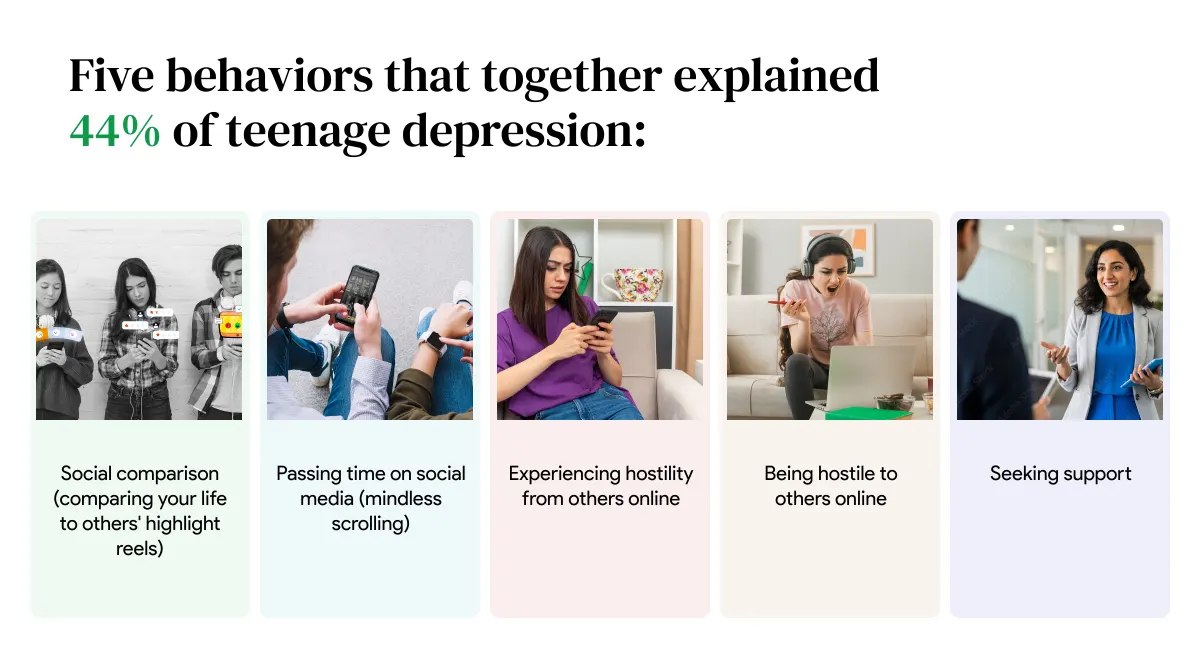
The two BIGGEST predictors of depression? Social comparison and passive time-wasting. In other words, scrolling through others' perfect lives when you're bored is a recipe for feeling terrible about yourself.
In August 2025 a groundbreaking study on Instagram use among Indian young adults was conducted and had found shocking results:
- 93% of participants used Instagram daily
- 32% were classified as "heavy users" (more than 3 hours per day)
- heavy users showed significantly higher levels of depression, anxiety, and stress
Both the amount of time spent and the type of content viewed independently predicted psychological distress. this wasn't just about screen time—it was about what people were looking at and how they were using the app.
Cognitive Overload, and Emotional Burnout
Love Reels, YouTube Shorts, and TikTok? You're not alone- 61% of Indian internet users watch short-form videos. But here's the problem: a systematic review of 23 studies published in January 2026 found that short-video addiction was consistently linked to the following:
- Attention problems (can't focus)
- Impaired executive control (can't make good decisions)
- Working memory issues (can't remember things)
Attention and self-control were the MOST affected areas. Even scarier? EEG brain scans showed that short-video addiction was negatively correlated with activity in the prefrontal cortex, the part of your brain responsible for reasoning, controlling impulses, and making decisions.
When you constantly switch between Reels, notifications, news, and WhatsApp without pausing, your brain doesn't just get tired. The evidence shows it becomes structurally damaged in its ability to pay attention and regulate emotions.
The Doom-Scrolling Problem
Doom-scrolling" is when you keep scrolling through bad news, depressing posts, or anxiety-inducing content even though it makes you feel worse.
Research shows that frequent smartphone checking makes tasks 19% longer to complete and reduces productivity by 22%. The disruption isn't just about time wasted—it's about the quality of attention that survives after constant interruption.
The worst part is that social media platforms are designed to keep you scrolling. features like infinite scroll, autoplay, and personalized notifications are specifically engineered to remove natural stopping points. they don't just encourage you to stay longer, they make it almost impossible to leave.
Mental Health Signs You May Need a Digital Detox
- Anxiety when not using your phone: The Social Media Fatigue and FOMO study (December 2025) by researchers Yolanda; Jaya, Monique Elizabeth Sukamto, and Made Ayudhyastiti Savita Putri found that Fear of Missing Out (FOMO) directly predicts social media fatigue a state of exhaustion and reduced motivation from chronic social media use. If you feel anxious, restless, or panicky when separated from your phone even for a few minutes—this is a stress response to disconnection, not just inconvenience.
- Disrupted sleep: Consistent difficulty falling asleep, waking unrefreshed, or using the phone as a sleep aid are signs that digital habits are likely a contributing factor.
- Low mood and social withdrawal: When the online world feels more accessible than the real one, or when seeing others' lives consistently makes you feel inadequate, these are signals worth taking seriously.
- Emotional reactivity: Constant app-switching and notification interruptions erode our capacity to regulate emotions. The result is often irritability and a low tolerance for discomfort that bleeds into relationships and work.
Why Unplugging Is Harder in India
Fear of Missing Out (FOMO) and Social Anxiety
A study examining 369 emerging adults found that FOMO directly and significantly predicts social media fatigue, with upward appearance comparison mediating this relationship, especially in male participants.
In a collectivist cultural context like India's, where belonging to family and peer groups carries deep psychological weight, FOMO is not merely inconvenient — it is socially threatening. Stepping offline from a family WhatsApp group or missing a peer's LinkedIn post is experienced not as a neutral absence but as a rupture in social connection.
Work-Related Stress and the Always-On Mindset
India's workplace culture is among the most demanding in the world. ILO data shows the average Indian employee works 46.7 hours per week, significantly above the global average of approximately 38 hours (International Labour Organization, 2023).
A Boston Consulting Group(BCG) survey of 11,000 workers across eight countries found that 58% of Indian respondents reported feeling burned out — the highest proportion among all countries surveyed, ahead of the United States (50%), the United Kingdom (47%), and Japan (37%).
When leaders glorify overwork and a late-night WhatsApp message from a manager is treated as normal, employees internalise an always-on standard that makes genuine unplugging feel professionally dangerous.
Digital Dependency and Structural Barriers
India's mobile data is among the world's most affordable, removing one of the natural friction points that moderates usage in higher-cost environments.
In countries with expensive data, people self-regulate because it costs money. In India, there's no such brake. You can scroll endlessly without worrying about your bill.
Globally, research estimates that 37.1% of people have problematic smartphone use. India's numbers suggest it may be even higher here.
Mental Health Benefits of a Digital Detox
The temporal dynamics of smartphone use reduction and its association with sleep quality, stress, and well-being provides the clearest consolidated evidences.
Less anxiety and stress
The smartphone reduction study found that people who limited phone use to ≤2 hours per day for three weeks showed a significant reduction in perceived stress. These improvements began within the FIRST WEEK, meaning your nervous system responds quickly to reduced digital stimulation.
Better Sleep
Sleep quality was the most immediate and measurable benefit, improving significantly within the first week. This matters beyond just rest. Sleep deprivation drives anxiety, depression, and emotional dysregulation. When you fix your sleep through digital boundaries, everything else improves too.
Emotional Stability
When you step away from constant stimulation, your prefrontal cortex—the brain's center for reasoning and emotional regulation—gets space to recover. Research shows that heavy users have reduced activity in this area. Detox isn't just rest; it's neurological healing.
Better Focus and Thinking
The systematic review found that attention and self-control are the cognitive functions most damaged by short-video addiction and therefore the functions most likely to recover with reduced use.
For Indian students and working professionals, the cognitive benefits of structured detox directly affect academic and career performance.
Stronger Real-Life Relationships
Paradoxically, being "connected" online is linked to increased loneliness. Passive consumption replaces genuine interaction. A digital detox redirects your attention toward in-person relationships and real human contact that actually reduces loneliness.
Mindfulness and Digital Detox
Mindfulness and digital detox are mutually reinforcing. Mindfulness trains the capacity to notice the impulse to check a device before acting on it – creating a moment of choice. This is particularly resonant in India, where contemplative traditions through yoga and meditation offer a cultural scaffold for this practice that is increasingly underutilised in favour of screen-based engagement.
Interestingly, a randomized controlled trial is currently underway at Istanbul University examining a mindfulness-based program specifically designed to reduce short-form video addiction in teenagers. This shows that combining mindfulness and digital detox is now being studied as a clinical intervention.
What to expect in the first 3 weeks of Digital Detox
Days 1–2: The Uncomfortable Phase
- You'll feel restless, irritable, or a persistent urge to check your phone
- This is normal—it means your brain is recalibrating
- This is not a sign of failure
Week 1: Noticeable Improvements
- Measurable improvements in sleep, mood, and stress
- You'll start feeling calmer
- The urge to check decreases
Weeks 2–3: Stabilization
- Gains consolidate into stable patterns
- New habits feel more natural
- Well-being improvements become consistent
When to Seek Professional Mental Health Support
A digital detox is a meaningful self-care tool. But it is not a substitute for professional mental health support when underlying distress is more serious. Consider reaching out to a mental health professional if:
- Screen use is the primary way you manage emotional pain or avoid difficult feelings
- Repeated attempts to reduce screen time fail despite genuine motivation
- Your digital habits are significantly harming your relationships, work, or physical health
- You are experiencing persistent low mood, anxiety, or sleep disruption that does not improve with lifestyle changes
Mental Health First Aid (MHFA) training equips individuals to recognise these signs — in themselves and in those around them — and to provide early, compassionate support while connecting people to professional care. In a country where the Economic Survey 2025–26 has called for expanded Tele-MANAS support and Digital Wellness Curricula in every school, the role of mental health first responders has never been more relevant.
Sources
- Temporal Dynamics of Smartphone Use Reduction and Its Association with Sleep Quality, Stress, and Well-Being — University for Continuing Education Krems & Danube Private University, Austria
- A Mixed-Methods Approach to Social Media Corrective Behaviors: From Antecedents to Outcomes — Research Team
- The Social Media Scale for Depression in Adolescence — Eve Twivy et al
- Instagram Usage and Mental Health in Young Adults: A Quantitative Study Using DASS-21 — Surbhi Nimbalkar et al
- Short Video Addiction and Its Impact on Cognitive Functioning in Adolescents and Youth: A Systematic Review — Bath Spa University Research Team
- Recreational Screen Time at University Entry and Mental Health and Well-Being Over First Year (U-Flourish Study) — Simran Brar et al
- Social Media Fatigue in Emerging Adulthood: The Role of FOMO and Appearance Comparison — Yolanda Jaya et al
- DataReportal – Digital 2025: India
- IAMAI Internet in India Report 2025
- Economic Survey 2025–26 - Indiabudget India
- The Mindfulness-Based Program for Short-Form Video Addiction — ClinicalTrials.gov
- U-Flourish Student Well-Being Study — Queen’s University, Canada
- International Labour Organisation (ILO) – Working Hours Data
- Meta-Analysis on Problematic Smartphone Use — 109 studies, 97,748 participants (Global prevalence: 37.1%)
Frequently Asked Questions (FAQ's)
Does digital detox help with anxiety and depression?
Yes. Studies show that limiting phone use to 2 hours or less per day significantly reduces stress and improves well-being within just one week. However, if you have clinical anxiety or depression, digital detox should complement professional mental health support—not replace it.
How does screen time affect mental health?
Too much recreational screen time is linked to higher anxiety, depression, sleep problems, and thinking difficulties. Heavy Instagram users show significantly elevated depression, anxiety, and stress scores. Both the amount of time and the type of content you view matter.
What are the signs that you need a digital detox?
Watch for anxiety when separated from your phone, disrupted or unrefreshing sleep, consistent low mood after social media use, difficulty concentrating, emotional mood swings, and using social media as your default response to any difficult feeling. Mindless scrolling and comparing yourself to others online are especially harmful.
How long does it take for a digital detox to improve mental health?
Measurable improvements in sleep, stress, and well-being can appear within the first week of limiting use to two hours a day. Sustained partial reduction over time is more effective than brief total abstinence. However, for those with an addiction to digital media, detox attempts may repeatedly fall short.
Can a digital detox help with sleep problems?
Yes! Sleep quality improves significantly within the first week of reduced phone use. Removing screens from your bedroom and avoiding phones in the hour before sleep are among the most evidence-supported starting points.
Is digital detox effective for emotional burnout?
Research links digital addiction to depression, stress, loneliness, and emotional fatigue through a dopamine depletion mechanism. Structured screen reduction allows your system to recover. However, you also need organizational changes and professional support alongside individual digital boundaries.
What is the connection between social media and depression in India?
Indian research found that 32% of young adult Instagram users are heavy users, with clinically elevated depression, anxiety, and stress (Sharma et al., 2025). The primary drivers — social comparison and passive scrolling — mirror the leading behavioural predictors of adolescent depression globally.