
Mental Health in the Pharmaceutical Industry: What the Data Says, and What to Do About It

What does it say about an industry when it supplies the world's mental health medication but has no systemic plan for the mental health of its own workforce?
India's pharmaceutical sector, valued at USD 50 billion in FY 2023–24 (Ministry of Chemicals and Fertilizers, Annual Report 2023–24), manufactures treatments for depression, anxiety, schizophrenia, and bipolar disorder. And yet, the mental health of the 2.7 million people keeping this industry running remains largely unaddressed, under-measured, and structurally ignored.
This is not a peripheral HR concern. It is a structural, economic, and leadership issue that demands boardroom attention.
What is Mental Health in the Pharmaceutical Industry?
Mental health in the pharmaceutical industry refers to the psychological, emotional, and social wellbeing of the people who work across every function of this sector — from the medical representative driving between clinics in all climates, to the R&D scientist watching a five-year project fail in late-stage trials, to the quality assurance officer managing a critical audit with no end in sight.
It is the ability of employees to cope with the routine demands of their roles, sustain performance without breaking down, maintain meaningful relationships at work and outside of it, and access support when the weight of the job becomes too much to carry alone.
What makes pharma industry uniquely high-risk for mental health?
The pharma world runs like a high-speed engine that rarely idles. Beneath the polished surface of science and sales lies a pressure ecosystem that quietly builds strain over time.
1. Relentless performance pressure: Medical representatives and sales teams operate in a target-driven culture where numbers are non-negotiable. Every month resets the scoreboard, keeping stress on a constant loop.
2. Always-on travel and isolation: Frequent travel, long hours on the road, and limited peer interaction can create a sense of isolation, especially for field teams who work independently most of the time.
3. Emotionally demanding interactions: Engaging with doctors, healthcare professionals, and sometimes patients requires emotional regulation, persuasion, and resilience, even on difficult days.
4. Strict compliance and regulation: The industry operates under tight ethical and legal frameworks. One misstep can have serious consequences, which adds a layer of cognitive and emotional pressure.
5. Stigma around vulnerability: Despite being in healthcare, conversations around personal mental health often remain limited. Many employees feel expected to “push through” rather than seek support.
6. Blurred work-life boundaries: Unpredictable schedules, extended workdays, and constant connectivity make it difficult to fully switch off, leading to burnout over time.
7. High competition and comparison culture: Internal competition, rankings, and performance benchmarking can intensify stress and impact self-worth.
Employee Mental Health in the Pharma Industry
Medical representatives (MR) are perhaps the most documented case. A 2025 paper by Basu et al., published in the International Journal of Community Medicine and Public Health, identified chronic stressors including ambitious performance expectations, toxic leadership behaviours, physical fatigue, and digital saturation. These lead to emotional exhaustion, detachment, and declining personal efficacy.
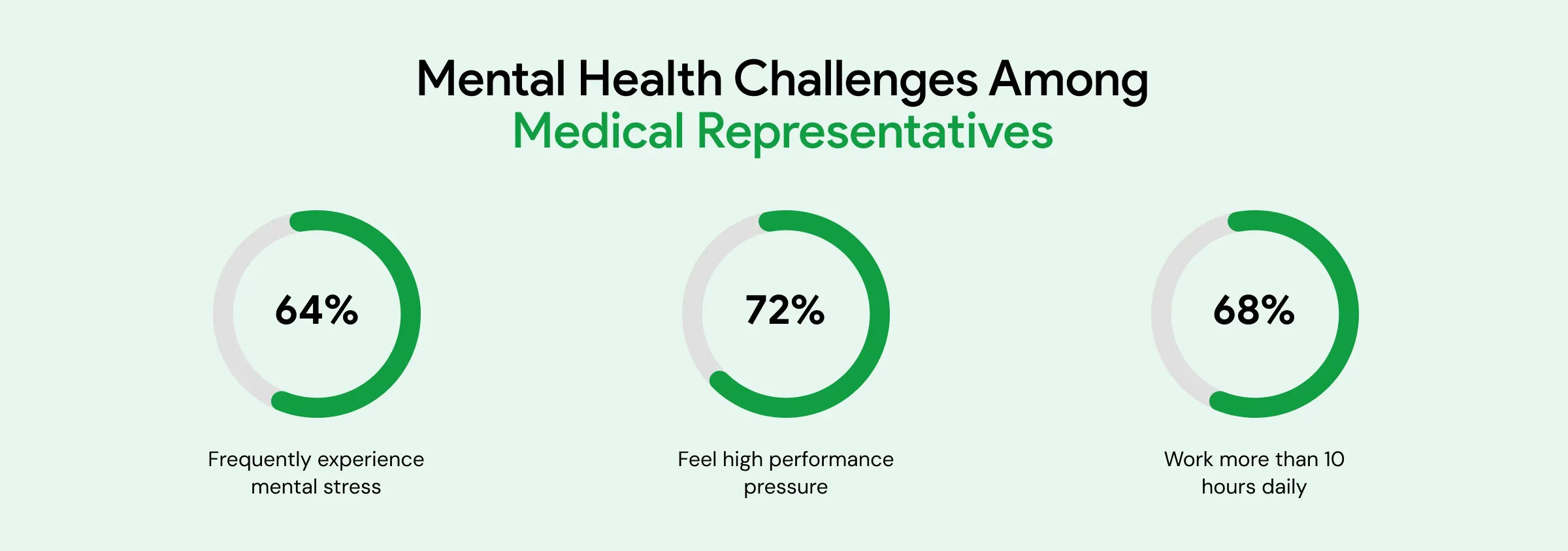
A 2026 field study by Tripathi reinforced this. Approximately 64% of Medical Representative respondents reported frequent mental stress, 72% perceived their performance pressure as high, and 68% worked beyond 10 hours daily.
Regulatory and R&D roles carry a quieter, heavier strain, shaped by perfectionism, fear of failure, and the emotional toll of uncertain outcomes. This distress is often invisible, making it more risky.
Another overlooked group is pharmacists and pharmacy staff, operating at the intersection of clinical responsibility and retail pressure, often under-resourced and target-driven. With nearly half the Indian workforce experiencing depression or anxiety, and ~80% not seeking support, their silence is even more pronounced due to the expectation that they should “know better.”
They don’t. Which is exactly why structured, accessible wellbeing programmes are critical for them.
Why Pharma Is Investing in Mental Health Support
Three forces are pushing the industry to act, all difficult to ignore.
Financial accountability is unavoidable
Deloitte India (2022) estimates ₹1.1 lakh crore lost annually due to poor employee mental health: ₹14,000 crore from absenteeism, ₹51,000 crore from presenteeism, and ₹45,000 crore from attrition.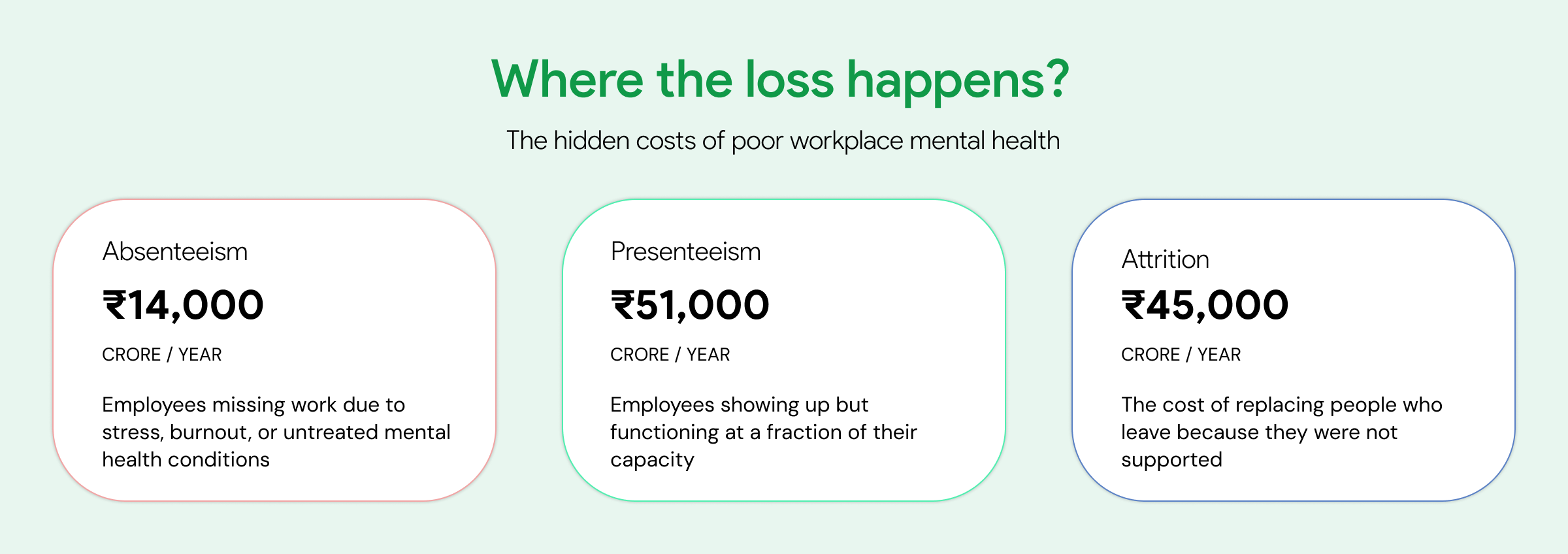
In pharma, attrition is especially costly, trained MRs, regulatory, and R&D talent take months or years to replace, along with lost knowledge and relationships. For leadership, mental health is no longer an HR initiative, but a core risk management priority.
Regulatory momentum is rising
Securities and Exchange Board of India’s BRSR now makes employee wellbeing a disclosed metric, while Insurance Regulatory and Development Authority of India mandates mental illness coverage on par with physical health under the Mental Health Care Act, 2017. Ignoring mental health today carries both compliance and legal risk.Talent and brand are shifting
Pharma professionals are less willing to trade wellbeing for output. Companies with visible mental health programmes, including MHFA training, attract better talent, improve retention, and stand out in a high-attrition market where employer brand directly impacts hiring costs and acceptance rates.The evidence is now strong
Research cited by MHFA India and studies in BMC Psychology confirm that MHFA improves literacy, reduces stigma, and drives early intervention. Pharma-specific studies (Basu et al., 2025; Tripathi, 2026) highlight burnout risks, especially among MRs, with manager capability as a key lever. The question is no longer whether to invest, but how fast and how systematically.What the Research Says About Mental Health Training at Work
Structured mental health programmes deliver measurable impact. A meta-analysis cited by MHFA India shows that MHFA training improves mental health knowledge, reduces stigma, and strengthens supportive behaviour.
A landmark systematic review published in BMC Psychology (March 2025) identified 11 rigorous studies evaluating MHFA training. The findings were consistent:
- Improved mental health literacy
- Greater confidence and intention to intervene
- Reduction in stigma
- Reduced social distance
These outcomes translate directly into earlier intervention and burnout prevention in workplace settings. One training cycle does not just help one person. It shifts how teams recognise and respond to distress.
Benefits of Mental Wellness Programmes for Pharma Staff
The returns on investment are well documented:
- Reduced absenteeism and presenteeism
- Lower attrition, especially among high-stress roles
- Improved team culture and psychological safety
- Stronger manager effectiveness and retention outcomes
- Better compliance with ESG and BRSR reporting requirements
In other words, mental health programmes are not peripheral initiatives. They are operational levers.
6 Steps to Promote Employee Mental Health in Pharma
Awareness without action is just well-informed inaction. Here is a structured, sequenced plan for pharma organisations at any stage of their mental health journey.
1. Build the Policy Foundation First
- A formal commitment to employee wellbeing, signed off by the MD/CEO (not just HR)
- Confidentiality protections ensuring disclosures don’t impact evaluations, promotions, or assignments
- Non-discrimination clauses aligned with the Mental Health Care Act, 2017
- Leave provisions for mental health on par with physical illness, without excessive documentation
- Clear escalation and referral pathways when distress is identified
The policy should be communicated at induction, reinforced by managers, available in regional languages, and reviewed annually. If employees can’t find or recall it, it isn’t effective.
2. Make Awareness Ongoing, Not Occasional
Single-day campaigns like World Mental Health Day create visibility, not impact. Awareness must be built into year-round operations:
- Tailor communication to role-specific stressors, speak to MRs, QA officers, regulatory teams, not a generic employee
- Use formats that reach field staff: WhatsApp-ready content, manager briefings, regional languages
- Make leadership visible; senior voices sharing pressure and recovery reduce stigma fastest
- Repeat communication on support resources; many don’t use them simply because they forget they exist
3. Audit and Upgrade What You Offer
Many pharma organisations have mental health benefits. Very few have checked whether they are accessible, adequate, or being used. Every CHRO should be able to answer:
- Are psychiatric consultations and therapy covered under insurance? If not, this may violate Insurance Regulatory and Development Authority of India’s October 2022 mandate
- Is professional care being used? Utilisation below 5% signals awareness or access gaps
- Are services available in regional languages for field staff?
Is there a confidential, low-barrier entry point for those not ready for formal care?
- Do remote and field employees have equal access as head office staff?
4. Build Psychological Safety Through Culture, Not Just Policy
For pharma’s dispersed, high-demand workforce, flexibility isn’t a perk, it’s essential for performance:
- Train managers to conduct regular, informal wellbeing check-ins as part of everyday management, not just during crises or reviews
- Reinforce through policy and behaviour that seeking support reflects self-awareness, not weakness
- Create peer support networks for field teams, enabling colleagues to offer initial support and guide others to help
- Audit performance management language. If emotional difficulty is treated as a liability, it quietly erodes every other mental health investment
5. Embed Flexibility as a Structural Commitment, Not a Manager's Discretion
Pharma measures everything. Mental health should be no different. A credible wellbeing measurement system includes:
- Let MRs self-schedule part of their weekly visits; autonomy is linked to lower stress and better output (Tripathi, 2026, IJERT)
- Offer remote or hybrid options for roles not requiring physical presence
- Build recovery periods into target cycles; sustained performance needs downtime
- Train supervisors to support, not surveil, distributed teams
- Review workloads regularly to spot burnout risks before attrition reveals them
6. Measure What Matters
Pharma measures everything. Mental health should be no different. A credible wellbeing measurement system includes:
- Regular, confidential, role-specific surveys on workload, stress, and psychological safety
- Absenteeism tracking, especially short-term patterns as early warning signs
- Attrition analysis by role, region, and manager to identify burnout hotspots
- Quarterly review of care utilisation, with action if high-risk groups underuse support
- Manager effectiveness treated as a leading indicator of team mental health
- Wellbeing metrics embedded into quarterly business reviews, not just annual HR reports
How Mental Health First Aid Training will help the Pharma Managers
Policies exist. Access to care exists. Awareness campaigns exist, but the first person a distressed employee approaches is usually their manager. And most managers are not trained for that moment.
Building Mental Health First Aid capacity at the manager level is the highest-impact intervention available.
MHFA training equips managers to recognise early signs of distress, respond with empathy, and guide employees toward appropriate support. It does not turn them into therapists. It makes them capable first responders.
The BMC Psychology review (2025) found improved confidence to intervene and stronger intent to act, both critical in real workplace situations. Basu et al. (2025) also emphasised manager training as a key solution to burnout among medical representatives.
Global guidance, including from the World Health Organization, reinforces this. Managers must be equipped to identify and respond to poor mental health within teams.
For pharma companies, this translates into three practical steps:
- Certify first-line managers in MHFA
- Embed MHFA awareness into induction programmes
- Ensure at least one trained individual is present in every major location
Conclusion
The pharmaceutical industry has the data. It has the regulatory mandate. It has the evidence base. What it has lacked, until now, is a structured path from intention to implementation. The six steps in this article are that path. They are not expensive to begin. They do not require a new department or a large budget. They require a decision — made at the top, owned across the organisation, and built into the way work actually happens.
The people making the medicines deserve the same rigour of care as the medicines they make.
Soures:
- NIMHANS (2015–16) — National Mental Health Survey; 150M need care; 84.5% treatment gap
- Deloitte India (2022) — Workplace Mental Health; ₹1.1L Cr cost; 80% affected; 39% stigma
- Basu et al. (2025) — MR Burnout Study; toxic leadership, pressure, emotional exhaustion
- Tripathi, A. (2026) — Work-Life Balance (MRs); 64% stress; 72% pressure; 68% work 10+ hrs
- BMC Psychology (2025) — MHFA Systematic Review; improves literacy, confidence, reduces stigma
- Ministry of Chemicals & Fertilizers (2023–24) — India pharma market ~USD 50B
- Mental Healthcare Act (2017) & IRDAI (2022) — insurance parity for mental illness
Frequently Asked Questions (FAQ's)
What is Mental Health First Aid (MHFA) and how is it relevant to pharma companies?
Mental Health First Aid (MHFA) is a globally recognised training program that equips individuals to identify, understand, and respond to mental health challenges. For pharmaceutical companies, it is especially relevant as employees—particularly medical representatives and sales teams—often face high stress, performance pressure, and emotional burnout.
Where can pharmaceutical companies find certified mental health courses for staff?
Pharmaceutical organisations can access certified MHFA training through Mental Health First Aid India, which offers evidence-based, structured programs tailored for workplaces, including pharma teams.
How can pharma companies enroll employees in MHFA programs?
- Visiting the MHFA India website
- Selecting suitable corporate training programs
- Scheduling sessions for teams (online or in-person)
- Customising programs based on organisational needs
What are the best mental health programs available for pharma companies in India?
One of the most effective options is the MHFA training, designed for both employees and managers. Offered by Mental Health First Aid India, this program follows a structured, globally aligned curriculum that equips teams with practical skills to recognise, respond to, and support mental health concerns in the workplace.
Are there mental health programs specifically for anxiety and depression management?
- Recognise signs of anxiety and depression
- Provide initial support using the ALGEE action plan
- Guide individuals toward appropriate professional help
How can pharma HR teams implement mental health workshops?
HR teams can partner with certified providers like MHFA India, identify key employee groups, schedule structured training sessions, integrate mental health into ongoing L&D programs and track impact through employee feedback and engagement.
What are the benefits of investing in mental health programs for pharma companies?
Investing in mental health programs delivers improved employee retention, reduced absenteeism, and better team productivity. Companies also benefit from a stronger workplace culture and enhanced employer branding in a high-attrition market.
Are MHFA programs covered under health insurance in India?
While MHFA training itself is typically not covered by insurance, some mental health services (like therapy or psychiatric care) may be included under corporate or individual health insurance policies, depending on the provider.
Where can pharma professionals find mental health resources in India?
MHFA India provides pharma professionals with resource hubs, helplines, educational materials, and workplace-ready guides tailored for employees, HR teams, and leadership.
Are there success stories of mental health initiatives in pharma?
- Improved employee engagement
- Reduced burnout
- Stronger trust between employees and management
- Better overall workplace culture
What programmes does MHFA India offer?
Standard MHFA, blended workplace and public formats, higher education programmes, suicide and non-suicidal self-injury prevention, manager training, refresher courses, awareness sessions, and instructor certification.